BEGA North America Solar Microgrid Case Study: Onsite Resilience in the Goleta Load Pocket
This blog post by the Clean Coalition highlights the economic, environmental, and resilience benefits of the BEGA North America Solar Microgrid.
BEGA North America Solar Microgrid Case Study: Onsite Resilience in the Goleta Load Pocket
For BEGA North America (BEGA), resilience is foundational to ensuring operational continuity, minimizing production disruptions, and supporting safe working conditions. Maintaining production schedules is critical to sustaining customer trust and upholding BEGA’s reputation for responsible operations.
BEGA is a manufacturing company specializing in high-quality architectural outdoor and indoor lighting, lighting control systems, and urban furniture. The Solar Microgrid is designed for BEGA’s Carpinteria campus, which includes manufacturing facilities, office space, and employee housing. This system has been operational since 2023, demonstrating sustained performance during both normal conditions and grid outages. Carpinteria is located along Santa Barbara’s South Coast within the Goleta Load Pocket (GLP), an area prone to grid instability and extended outages. The GLP is a grid-vulnerable and geographically isolated 70-mile stretch at the end of Southern California Edison’s electrical grid. A majority of power is delivered via a single set of transmission lines that pass through mountainous terrain at high risk of fires, Public Safety Power Shutoffs (PSPS), and other natural hazards. Southern California Edison (SCE) has acknowledged that damage to the lines could result in an extended outage of weeks or months.
These challenges are not unique to BEGA but instead reflect systemic vulnerabilities in the South Coast’s electrical infrastructure. As highlighted in Roadmap to Recovery: Power On, a report prepared by the Santa Barbara South Coast Chamber of Commerce, the increasing frequency of outages and PSPSs, combined with aging grid infrastructure and persistently high electricity costs create a structurally constrained energy environment for regional businesses. For manufacturers in particular, whose operations depend on continuous and highly coordinated production schedules, even brief power interruptions can halt production, disrupt supply chains, damage products, and generate cascading cost increases. In this context, the challenge is not only frequency of disruptions, but the ability of facilities to sustain operations when these disruptions occur. Grid instability therefore does not merely create an inconvenience but also constrains regional industrial productivity and operational reliability.
Under these conditions, BEGA has chosen to prioritize an onsite solution that can both maintain a reliable supply of onsite electricity and provide resilience—the ability to withstand disruptions and restore power quickly after an outage. Reliance on uninterrupted power introduces operational and safety risks within the manufacturing environment if a reliable supply of energy is not maintained. When grid-powered machinery unexpectedly stops, it can be difficult to preserve worker safety and the abrupt departure from the manufacturing schedule may lead to shipment delays or even breaches of contractual commitments with clients.
A Solar Microgrid offers an efficient solution to address BEGA’s needs; microgrids provide an unparalleled trifecta of economic, environmental, and resilience benefits.
Solar Microgrid Design Process
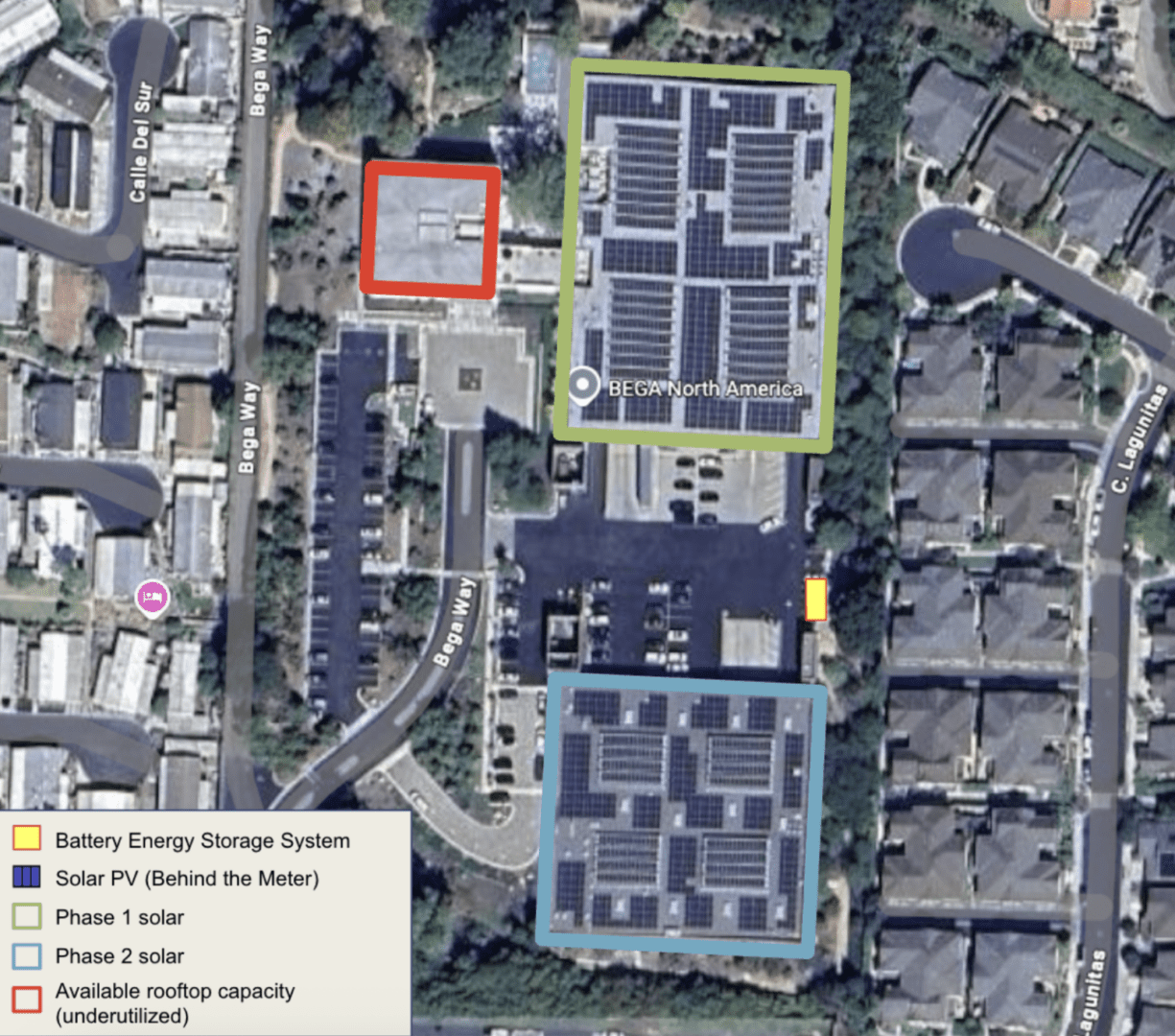
In partnership with HES Solar, a San Diego-based solar and battery storage installer, BEGA designed and deployed a Solar Microgrid consisting of 2,008 SunPower SPR-A450-COM solar panels and two Tesla Megapack batteries. The system functions as two distinct solar+storage configurations, deployed in two phases (see the image below). Phase 1(outlined in green) is sited on the northern manufacturing facility and consists of 560.7 kWdc of solar paired with 543 kW/2,172 kWh of storage. Phase 2 (outlined in blue) is located on the southern manufacturing facility and comprises of 318.6 kWdc of solar paired with 271 kW/1,087 kWh of storage. The two Tesla Megapack batteries (yellow with a red border)—each providing storage for a respective phase—are sited between the two manufacturing buildings. This enables BEGA to meet approximately 90% of its annual demand for electricity with onsite renewables, while providing up to 12 hours of resilience even during the worst-case outage conditions (e.g. a rainy day with maximum load usage).
BEGA Solar Microgrid Site Layout and Resource Deployment
BEGA took specific precautions during the Solar Microgrid design process to ensure minimal visual and land-use impacts on the surrounding area, reflecting an integrated and unobtrusive design approach. By deploying the solar array on existing rooftop infrastructure rather than undeveloped land, the project avoids additional land disturbance while reducing visual impacts to nearby residents. Elevated roof perimeters further conceal the solar, making it relatively invisible from ground-level vantage points while maintaining the solar’s full operational capabilities.
Resilience Benefits
A defining capability of BEGA’s Solar Microgrid is the ability to sustain critical operational loads during grid outages. Resilience is enabled by the system’s battery storage, which stores onsite solar generation and deploys it when grid power is unavailable. This allows manufacturing operations to withstand grid interruptions, preserving critical operations and supporting a safe workplace for employees. In the event of a PSPS or blackout, the microgrid automatically transitions into islanded operations, meaning BEGA’s core functions are able to continue independently of grid conditions. With a fully charged battery, the system can sustain building loads for a minimum of 12 hours under the worst-case conditions.
To extend their operations during islanding conditions, BEGA North America’s Facilities and Environmental Health and Safety Manager Ivan Gregory facilitates a manual load shedding protocol; HVAC systems are reduced or temporarily shut off, non-essential lighting loads (approximately half of the total lighting demand) are reduced, the water system is secured, and non-critical loads are curtailed. This enables the facility to rely on solar production (depending on the time of day) and extends the state of charge of the battery past the 12-hour minimum duration. During favorable solar generation conditions, BEGA may have indefinitely renewables-driven resilience.
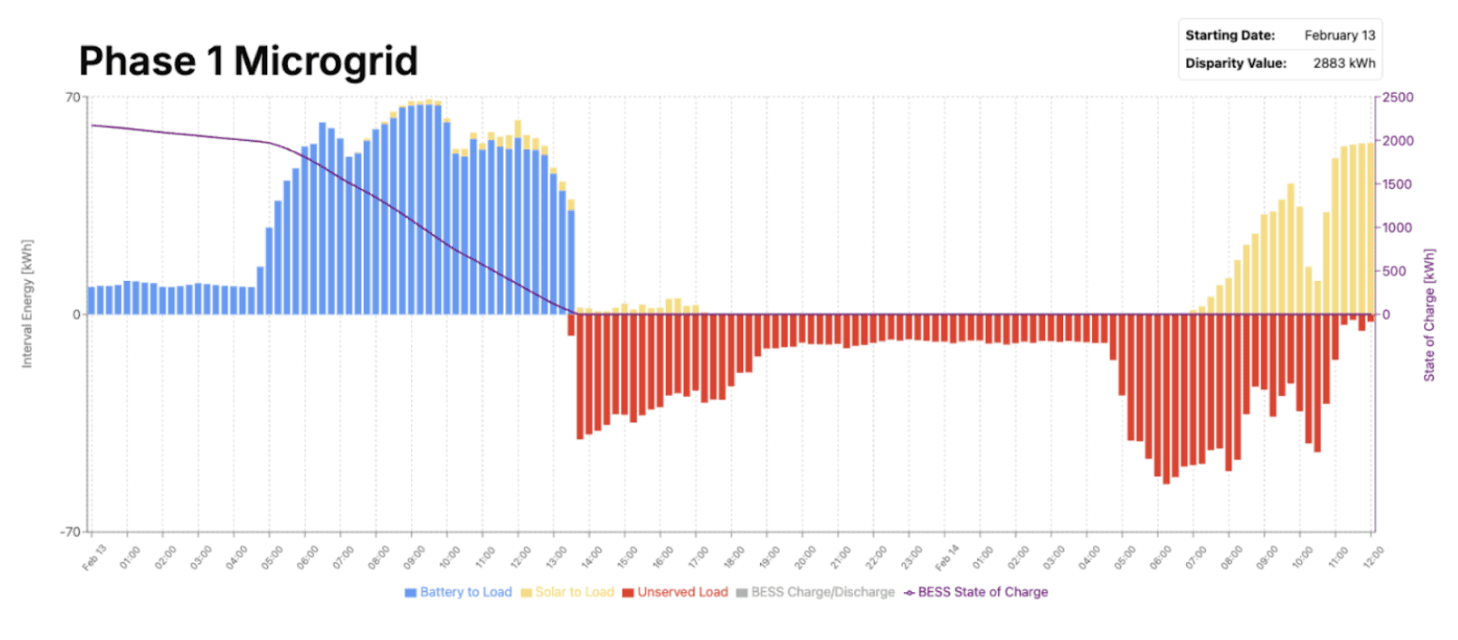
Worst-Case Outage Resilience Performance: Phase 1 (Year 1)
The resilience capabilities of the Solar Microgrid are not theoretical, as BEGA’s microgrid has already proven to be effective under actual grid disruptions. During the 2024 wildfire season, SCE facilitated multiple PSPS events throughout the month of July. According to Gregory, power would drop for anywhere between 20 minutes to 1.5 hours almost every morning for two weeks straight. For manufacturers like BEGA, the morning hours are critical to initiating production, making disruption during this window particularly consequential.
While other neighboring manufacturers were forced to halt operations due to loss of grid power, BEGA’s microgrid sustained manufacturing activities without interruption. This repeated performance in response to numerous grid outages demonstrates the value of resilience (VOR) in practice—it may be challenging to quantify in theory, but the real-world value when business operations can be maintained is overwhelmingly clear.
Economic Benefits
In addition to the value of resilience, BEGA’s Solar Microgrid provides long-term economic benefits. To finance the deployment, BEGA leveraged a combination of federal and state incentives, including the federal Investment Tax Credit (ITC), accelerated depreciation under federal and California tax codes, and California’s Self-Generation Incentive Program (SGIP). These programs support capital investment in distributed solar and storage systems, improving project feasibility.
To ensure consistency and replicability, economic modeling performed by the Clean Coalition used industry-standard installed cost assumptions of approximately $3.50 per watt-dc for solar and $1,500 per kilowatt-hour for the battery storage. Based on this methodology, in Year 1 of operation, the Phase 1 and Phase 2 solar arrays reduced BEGA’s electric bill by approximately 76% and 74%, respectively. While solar generation contributes to the electricity bill cuts, the battery storage is the primary driver of savings. Solar production from BEGA’s panels peaks midday (from approximately 10 AM – 3 PM), while facility demand continues into later periods when electricity costs are higher. By storing excess solar energy and discharging it during these peak periods, the system reduces reliance on grid electricity during high-cost periods and limits demand spikes.
For manufacturing facilities like BEGA with continuous production requirements, energy cost volatility can introduce operational uncertainty. Solar Microgrids reduce this uncertainty, aligning energy supply with operational demand and reinforcing stability.
Environmental Benefits and Sustainability Efforts
BEGA’s Solar Microgrid provides several environmental benefits by reducing reliance on centralized grid energy, which is often powered by high percentages of fossil fuels. The Microgrid meets approximately 90% of its annual energy demand with onsite, zero-emissions generation. Powering electrical loads with onsite energy generation also helps reduce strain on the grid during periods of high system load (peak demand), when electricity is more likely to be supplied by natural gas peaker plants, thereby reducing associated greenhouse gas emissions. From a land use perspective, siting the solar on existing rooftop infrastructure minimizes land disturbance and avoids environmental impacts associated with ground-mounted solar deployed on undeveloped land.
Beyond the microgrid, BEGA has implemented additional measures to reduce its environmental footprint across campus operations. The facility includes 10 level 2 electric vehicle (EV) chargers available for use by employees—with access managed through a structured scheduling system to ensure equitable usage—and is in the process of transitioning to electric forklifts. These efforts further reduce onsite emissions associated with daily operations and employee activities.
Taking sustainability a step further, BEGA’s emphasizes material responsibility across the product lifecycle. The solar system achieves a Silver rating under the Cradle-to-Cradle sustainability framework, indicating that approximately 90% of system materials are recyclable at end-of-life. In parallel, BEGA maintains a comprehensive recycling and waste management program, diverting 94% of campus waste from landfills (as of 2022). Revenue from recycled materials, including pallets, cardboard, and scrap metal helps offset the cost of managing e-waste and other hazardous materials. In recognition of these efforts, BEGA received the 2023 Green Business of the Year award from the Santa Barbara South Coast Chamber of Commerce, honoring these significant strides toward carbon reduction and sustainability.
Limitations of Current DER Compensation Frameworks
Although BEGA has additional unused rooftop space (see BEGA Solar Microgrid Site Layout and Resource Deployment image above), current distributed energy resource (DER) compensation policies limit the ability to deploy additional solar capacity that could otherwise support community energy needs and local grid resilience. Under California’s Net Energy Metering (NEM) program, solar installations are compensated to offset onsite consumption rather than to maximize onsite generation potential. This constraint limits the development of Community Microgrids, which provide indefinite, renewables-driven backup power for critical community facilities such as fire stations, hospitals, and emergency shelters across an entire section of the distribution grid.
The result is a stranded siting opportunity at BEGA. While the campus has sufficient built environment space to support additional solar deployment, current policies prevent the campus from maximizing its economic, environmental, and resilience benefits for our communities.
This constraint reflects a broader limitation with existing DER compensation frameworks, as demonstrated by the Direct Relief Solar Microgrid case study. At the site level, additional solar development is technically feasible and aligned with broader policy goals of clean energy expansion and local resilience. Community-scale generation from these systems could support nearby critical facilities and reduce reliance on transmission-interconnected generation.
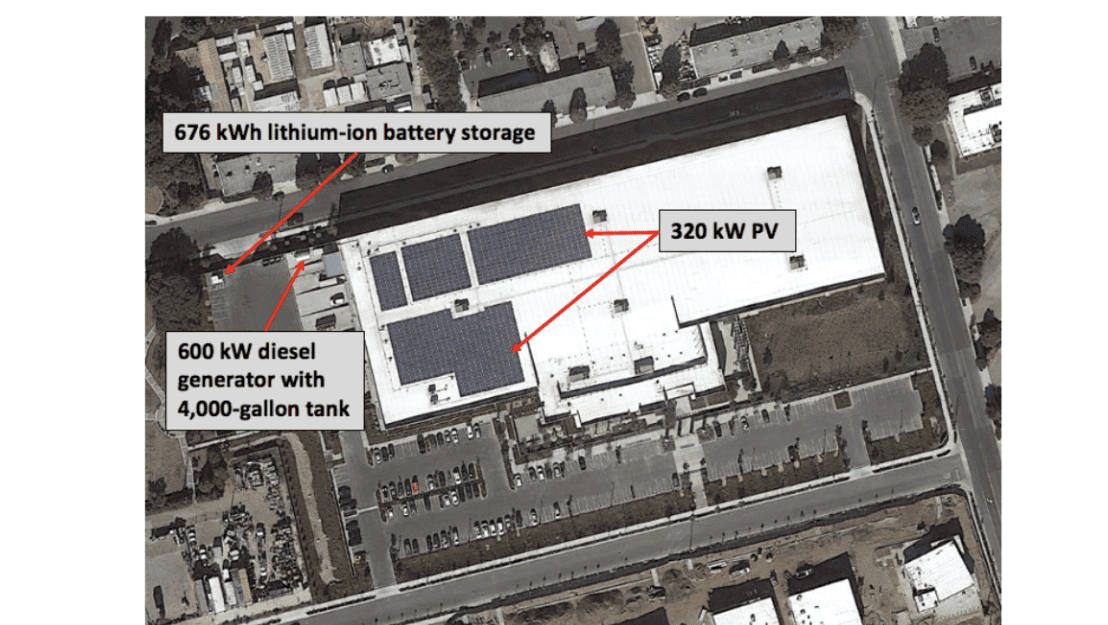
Direct Relief’s Goleta site layout as of 2021. As can be seen, there is ample space on the facility’s rooftop and parking lot for far more solar.
This limitation is not related to technical feasibility, but rather a gap in DER compensation programs. Without a compensation mechanism that values community-scale generation, facilities like BEGA remain constrained from utilizing available rooftop space to support Community Microgrids and enhance local energy resilience.
Conclusion and Implications
BEGA’s Solar Microgrid demonstrates the practical value of distributed solar and storage in sustaining critical operations during grid outages. Through the deployment of onsite energy generation and battery-supported islanding, the microgrid provides a resilient solution to vulnerabilities inherent in the GLP. While the project delivers measurable economic, environmental, and resilience benefits, it also highlights a broader limitation—current DER compensation frameworks constrain the ability of similar facilities to fully utilize available built environment capacity. Amending or expanding these frameworks to value community-scale generation would unlock additional opportunities for resilient, distributed energy systems across the region.