Santa Barbara County Prepares to Unleash Solar Across the Built Environment with Clean Coalition Guidance
A flawed definition of utility-scale solar has blocked local renewable energy development in Santa Barbara County needed to meet clean energy and resilience goals. The Clean Coalition has spent years working to address this barrier, and the finish line is in sight!
Santa Barbara County Prepares to Unleash Solar Across the Built Environment with Clean Coalition Guidance
A flawed definition of utility-scale solar has blocked local renewable energy development in Santa Barbara County needed to meet clean energy and resilience goals. The Clean Coalition has spent years working to address this barrier, and the finish line is in sight!
For more than a decade, Santa Barbara County’s solar permitting framework has contained a critical flaw. A single overly restrictive definition of Utility-Scale Solar has prohibited any front-of-meter solar—facilities connected on the utility side of the electric meter—from being developed across the County. This interconnection pathway is essential to the development of microgrid systems necessary to achieve the County’s renewable energy and resilience goals. The Clean Coalition identified this barrier and persistently raised the issue with the Board of Supervisors, setting in motion a multi-year effort that is on the cusp of fundamentally streamlining how the County permits solar and solar+storage projects.
Utility-Scale Solar in the Land Use Element of the Santa Barbara County Comprehensive Plan and Land Use & Development Code (LUDC) has been defined as:
“Facilities that are connected to the electrical grid on the utility side of the electric meter and are built for the primary purpose of generating and selling wholesale power. The electricity generated by the facility is not primarily used for on-site activities (such as farming or domestic water heating).”
Under this definition, utility-scale solar energy facilities are only permitted on 600 acres of land in New Cuyama Valley, an area north of the Goleta Load Pocket.
In practical terms, the County classifies projects based on how electricity is routed, without consideration for physical footprint and environmental impact. Any solar development interconnected on the utility side of the customer electric meter that exports power to the grid, rather than using it to serve the project location’s energy demand, can be treated as utility-scale. This is not a characteristic unique to large-scale solar farms.
Take two physically identical solar canopies over a community center parking lot. If the canopy is connected on the customer side of the electric meter, or behind-the-meter, and primarily offsets the community center’s electricity use, it is treated as a smaller distributed energy project. If the same canopy is configured front-of-meter to export power to the grid, participate in a community solar program, or support a nearby Community Microgrid, it is classified as utility-scale. This demonstrates why the definition is overly restrictive in practice. The physical footprint, location, and environmental impact are identical, only the interconnection and intended end use of the energy differs. By failing to account for these project aspects, the definition restricts solar developments that are essential to meeting local clean energy targets and enabling energy resilience.
This restrictive ordinance also puts Santa Barbara County out of step with state environmental law. Under the California Environmental Quality Act (CEQA), solar installations on built environments—rooftops, parking structures, and parking lots—are generally exempt from CEQA environmental review under a statutory exemption, rather than requiring a Negative Declaration or full EIR. In practice, this means the state has determined built environment solar typically poses so little environmental risk that it warrants streamlined treatment. Despite California’s policy of streamlining solar on existing built environments under CEQA, Santa Barbara County continues to apply a broadly restrictive definition of Utility-Scale Solar, positioning the County as an outlier rather than a climate policy trailblazer.
The consequences of this policy misalignment reach well beyond a permitting technicality. Southern Santa Barbara sits within the Goleta Load Pocket (GLP), a 70-mile stretch of the California Coastline located at the end of Southern California Edison’s (SCE) grid. One set of transmission lines run through 40 miles of fire-prone, mountainous terrain, making the area extremely vulnerable to extended grid outages. The solution to the lack of resilience and local reliability challenges is a Community Microgrid, powered by local solar and energy storage.
As outlined by the Clean Coalition’s Goleta Load Pocket Community Microgrid Initiative, installing 200 MW of solar and 400 MWh of energy storage within the GLP can provide resilience in the face of a substantial grid outage. 200 MW of solar can sound like an intimidatingly large amount of solar, but this threshold represents just five times the amount of solar currently installed in the region. Assuming that all solar is deployed on built environments, achieving 200 MW of solar will only require 7% of the commercial-scale solar siting potential on GLP rooftops, parking lots, and parking structures.
The 2019 Strategic Energy Plan: A Window for Change
In September 2019, the Board of Supervisors held a hearing on the Santa Barbara County Strategic Energy Plan (SEP), a comprehensive framework for advancing the County’s renewable energy goals, offering a direct opportunity to address the County’s flawed definition of Utility-Scale Solar. Under Phase One of the SEP implementation strategy, County staff recognized the limited allowance for development of Utility-Scale Solar as a barrier to renewable energy and recommended the development of a Utility-Scale Solar Ordinance to expand zoning allowance. The Clean Coalition saw that expanding zoning allowance alone fell short of reaching the underlying problem; the definition itself needed to change.
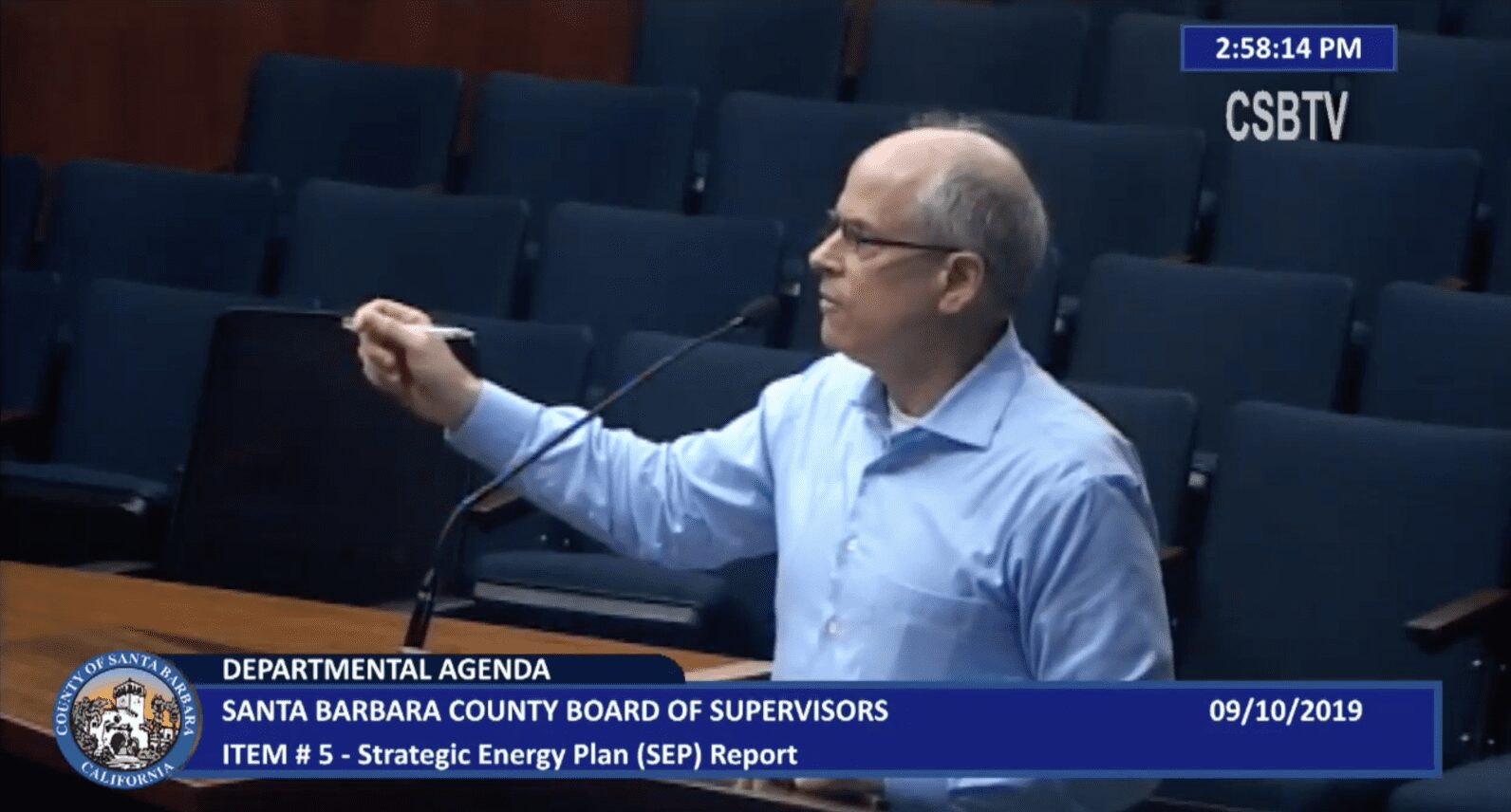
Through a written comment and in-person testimony, Clean Coalition leaders Craig Lewis, Ben Schwartz, and Gregory Young educated the Board on the current Utility-Scale Solar definition’s misalignment with CEQA standards and clearly demonstrated why the inability to site solar on built environments in the County could jeopardize the ability to achieve energy goals under development in the SEP. The Clean Coalition’s comments outlined a clear and targeted fix: amend the definition to explicitly exclude solar on built environments. Without this intervention, Utility-Scale Solar permitting amendments in the County would have been limited to expanding zoning allowance alone. The Board passed the SEP, directing staff to revise the Utility-Scale Solar ordinance in accordance with the Clean Coalition’s recommendations.
Clean Coalition Executive Director, Craig Lewis, gives public comment at the September 10, 2019, Santa Barbara County Board of Supervisors Hearing.
By July 2021, the scope of the proposed definitional change had grown into the broader Utility Scale Solar Comprehensive Plan and Ordinance Amendments project, and with further direction from the Board, expanded into a wider set of zones and land use categories. The expansion of scope necessitated a multi-year environmental review process, resulting in the release of a Draft Environmental Impact Report (PEIR) in August 2025.
The County’s initial proposed Utility-Scale Solar Ordinance Amendments analyzed in the PEIR revise the existing definition and zoning restrictions of Utility-Scale Solar by creating a tiered system of solar energy systems and facilities. Distinctions separating requirements for front-of-meter solar and behind-the-meter (BTM) solar are eliminated and would be replaced with tier classification based on project scale, footprint, site type, and permit pathway.
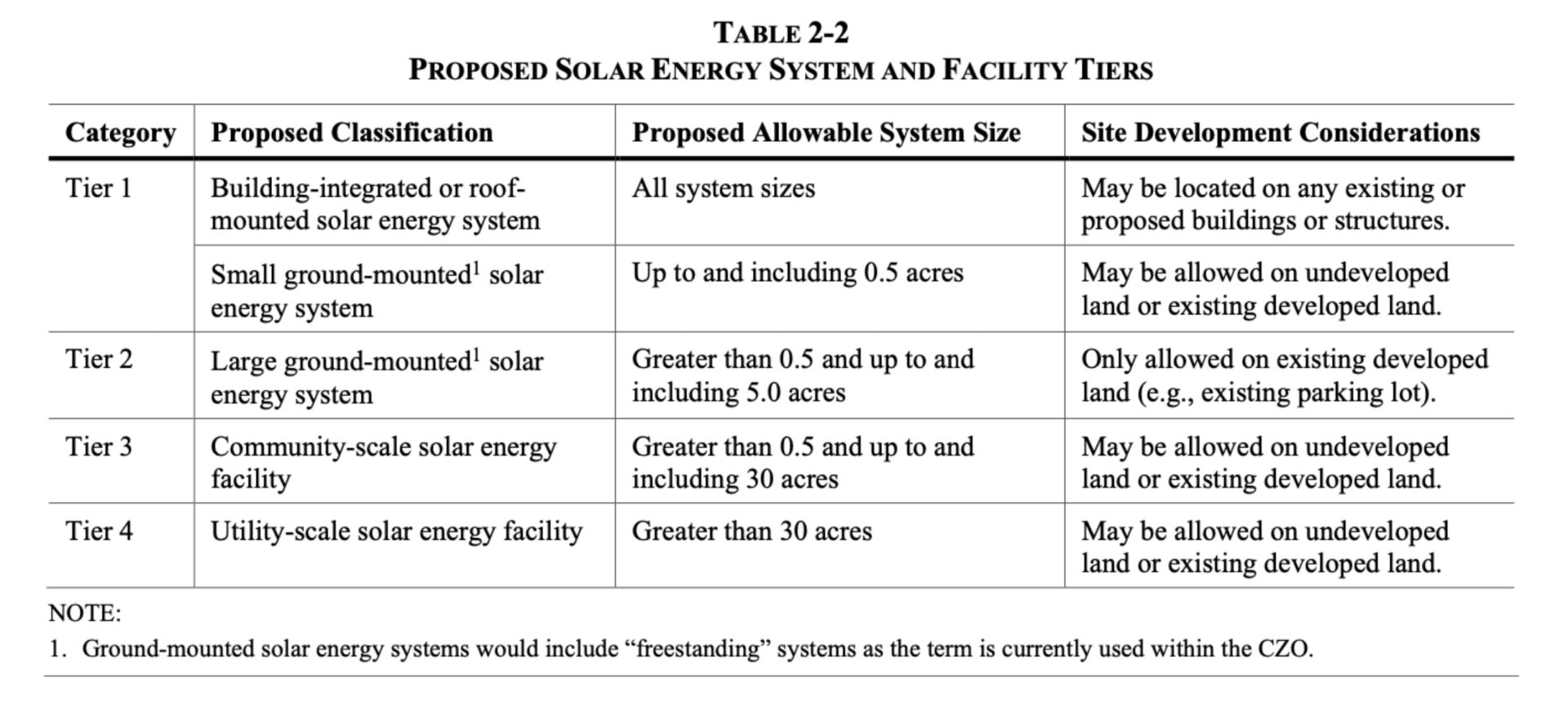 Initial proposed Solar Energy System and Facility Tiers shows the proposed category of tiers, ranging from 1-4, with each allowable size and classification.
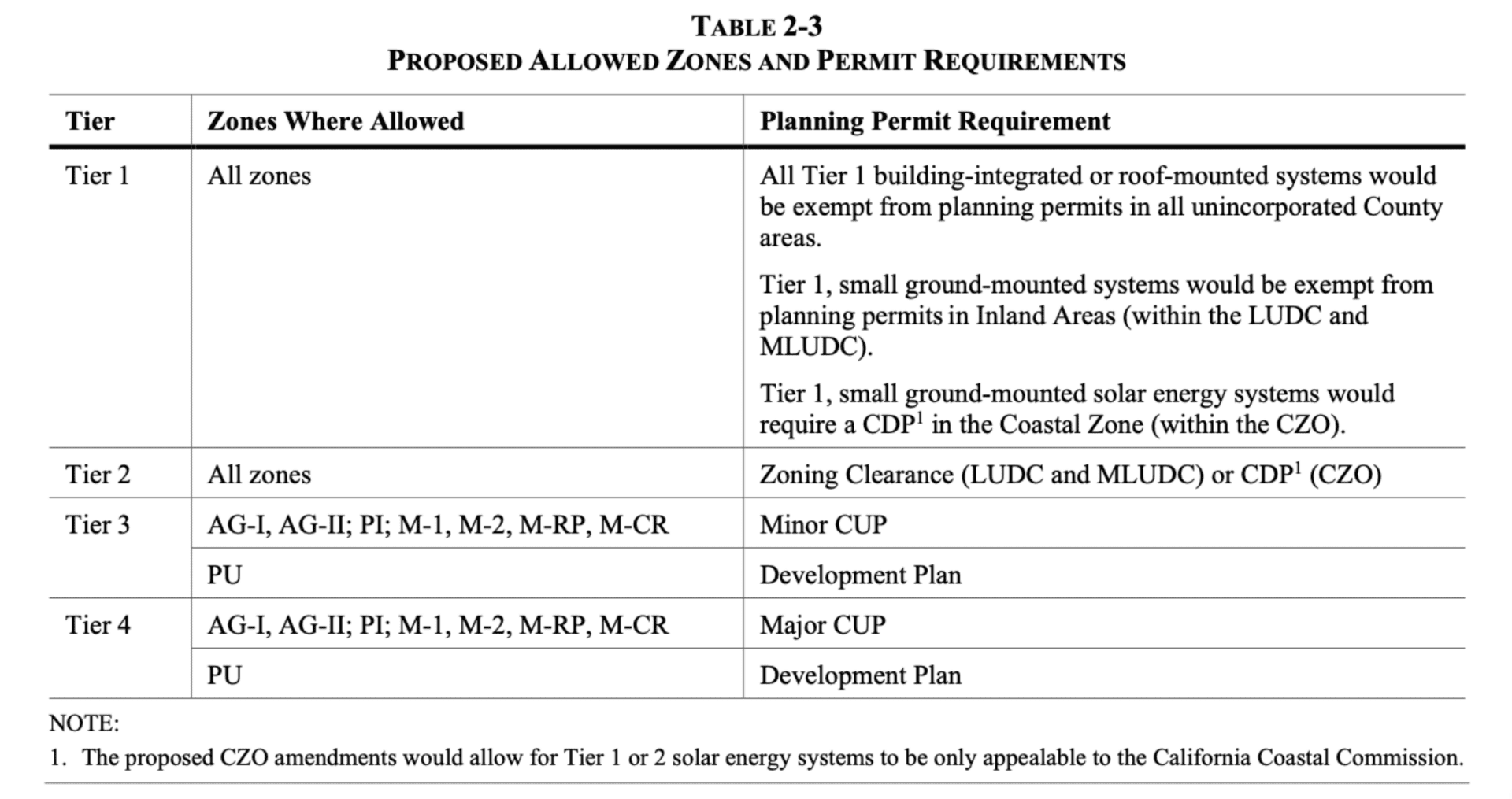 Proposed Allowed Zones and Permit Requirements indicate where a project in each tier would be allowed to be deployed and the type of planning permit required, if any.
The proposed framework categorizes building-integrated and rooftop at any size, and small ground-mounted solar systems up to 0.5 acres as Tier 1 projects, granting them exemptions from any additional permitting requirements. Larger projects are categorized in tiers 2-4, with each project spanning a greater acreage requiring a more resource intensive planning permit pathway. The tiered permitting structure is intended to scale regulatory review based on project land-use impact, allowing smaller installations and projects deployed on a built-environment to proceed without additional review while reserving discretionary review for larger projects with a greater potential for significant environmental impacts. The framework also considers batteries:
- Standalone battery energy storage systems (BESS) of any size would be subject to the same development standards as BESS components of Tier 3 or Tier 4 solar facilities.
- Paired solar+storage would qualify for Tier 1 exemption if the total size of the battery, solar, and all new or modified structures remained within the 0.5 acres limit.
Progress was clear, but the Clean Coalition identified several areas where the draft ordinance fell short of its stated goals to streamline permitting and facilitate renewable energy deployment. Through a written public comment in collaboration with Community Environmental Council (CEC) and verbal public comments from Ben Schwartz and Isabel Stice at the March 11, 2026 Santa Barbara County Planning Commission Hearing, the Clean Coalition emphasized seven targeted recommendations focused on four core issues.
- Parking Canopy Solar was miscategorized as a “Large ground-mounted solar energy system” under Tier 2. Classifying built environment solar alongside ground-mounted development, despite sharing no similar land-use or habitat impacts, created the very permitting barrier the ordinance was directed to amend.
- The draft also proposed burdensome requirements for solar+storage and standalone storage projects, a critical gap given that storage is essential to the resilience goals at the heart of the SEP.
- The draft also introduced new permitting requirements for behind-the-meter solar projects– systems that had previously been exempt from additional planning permits.
- Finally, the ordinance provided no clear methodology for calculating project acreage, leaving applicants uncertain whether size thresholds applied to the project footprint or total parcel size.
The Planning Commissioners recognized the importance of the Clean Coalition’s concerns, voting unanimously to continue the discussion to May and directing County staff to incorporate the Clean Coalition’s recommendations or explain how those recommendations had already been addressed, as covered in the Santa Barbara Independent. After meeting directly with Clean Coalition staff, County staff released revisions that addressed a majority of the core recommendations: Tier 1 and Tier 2 were consolidated so that Parking Canopy Solar at any size and BTM projects up to 5 acres would be exempt from additional permitting requirements, Tier 1 solar projects with up to 10 MWh (0.25 acres) of paired storage would remain exempt from additional permitting requirements, and acreage calculations were clarified to be determined by the size of a project’s renewable energy structures. On the May 6, 2026, the Planning Commission voted 4-0 to recommend the revised ordinance for adoption by the Board of Supervisors.
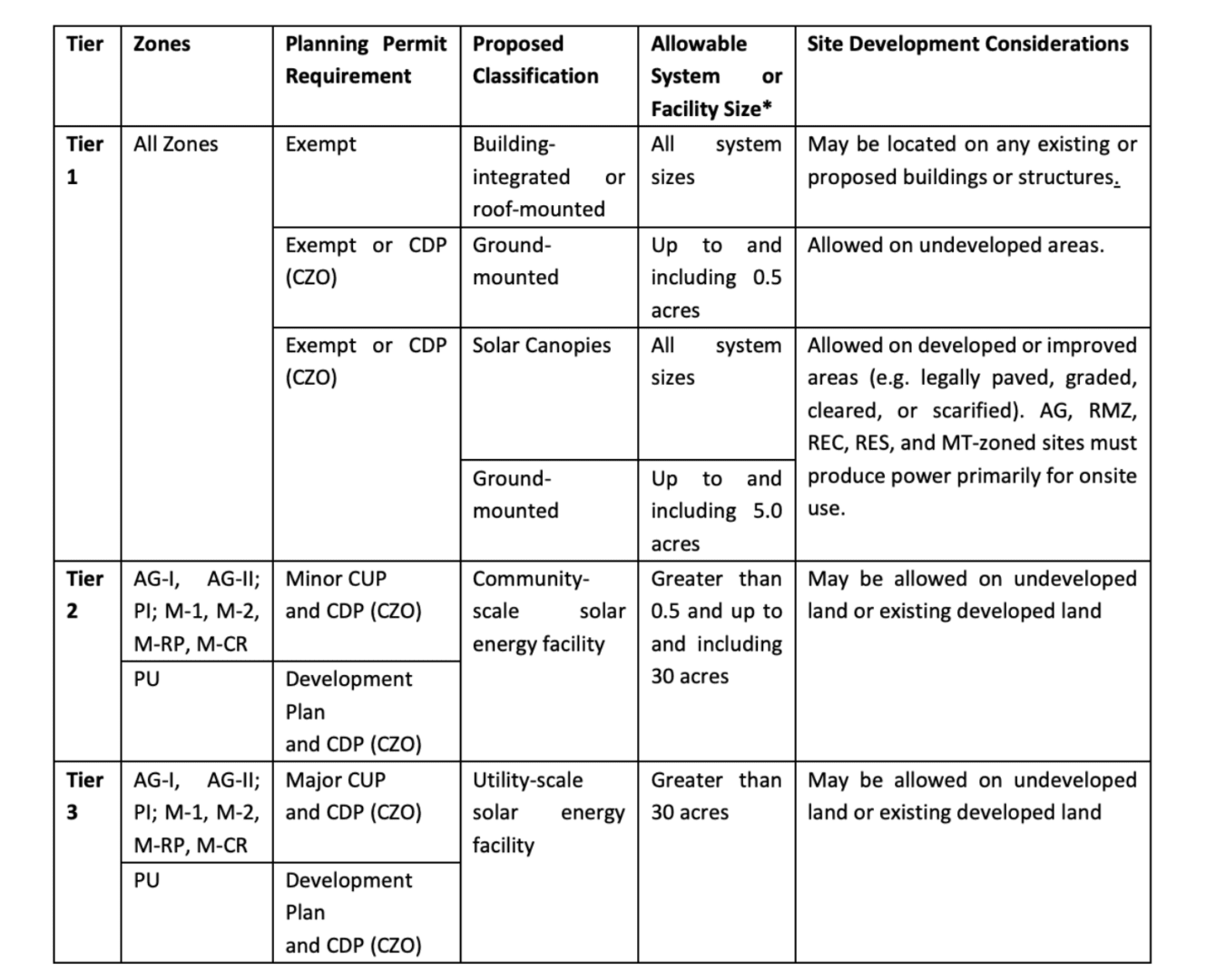
Revised Permitting Tiers for Solar System and Facilities with the inclusion of Clean Coalition comments.
Despite significant progress to solving a longstanding issue, Clean Coalition is seeking to dismantle one last roadblock limiting opportunities for energy resilience in the County: deploying standalone storage under 10 MWh on built environments. The proposed ordinance going to the Board categorizes any standalone storage in Tier 3 or 4, leading to a resource intensive and burdensome permitting requirement. However, a standalone battery under 10 MWh possesses the same footprint and land-use impacts as its paired solar+storage equivalent. The proposed ordinance is inconsistent when it comes to energy storage; classifying projects based on configuration rather than measurable impact restricts opportunities for much needed projects. Addressing this remaining gap would complete the framework, unlocking the full resilience potential the ordinance is positioned to deliver.
The Board of Supervisors hearing on July 14, 2026, is the final chance to address the “energy storage” gap and see this significant policy improvement across the finish line. What began as a single flawed definition, has, through years of persistent Clean Coalition involvement, evolved into a comprehensive framework that will meaningfully accelerate local solar and storage deployment needed to serve the Goleta Load Pocket. Including standalone storage is the final piece that will be the difference between a policy that streamlines solar and one that ensures a resilient energy future for Santa Barbara County.