Striking GOLD: Using Distributed Energy Resources to Optimize the Electric Grid
The GOLD framework unlocks the full value of DER to increase grid capacity, lower ratepayer costs, accelerate electrification, and strengthen resilience.
Striking GOLD: Using Distributed Energy Resources to Optimize the Electric Grid
Unlocking the full value of DER to increase grid capacity, lower ratepayer costs, accelerate electrification, and strengthen resilience.
California does not have the luxury of wasting grid capacity. California expects electricity demand to grow substantially as transportation, buildings, industry, and other large loads electrify. Billions of dollars of new transmission and distribution infrastructure are therefore being proposed, and customers seeking to connect new loads are increasingly being told that the grid does not have enough capacity. Yet, at the same time, much of the electric grid operates well below its maximum capacity during most hours of the year.
Building more infrastructure is part of the solution. But grid expansion cannot be the only answer to every grid constraint. California also needs to get far more out of the infrastructure and distributed resources already connected to the grid — both to control costs and accelerate electrification.
Grid Optimization by Leveraging Distributed Energy Resources (GOLD) is a framework for accomplishing exactly that. By strategically deploying and orchestrating solar, energy storage, electric vehicles (EVs), flexible loads, smart inverters, and other distributed energy resources (DER), the grid can operate more efficiently, make better use of existing infrastructure, and support growing electricity demand.
GOLD provides value across three fundamental dimensions: grid balancing, speed-to-power, and resilience.
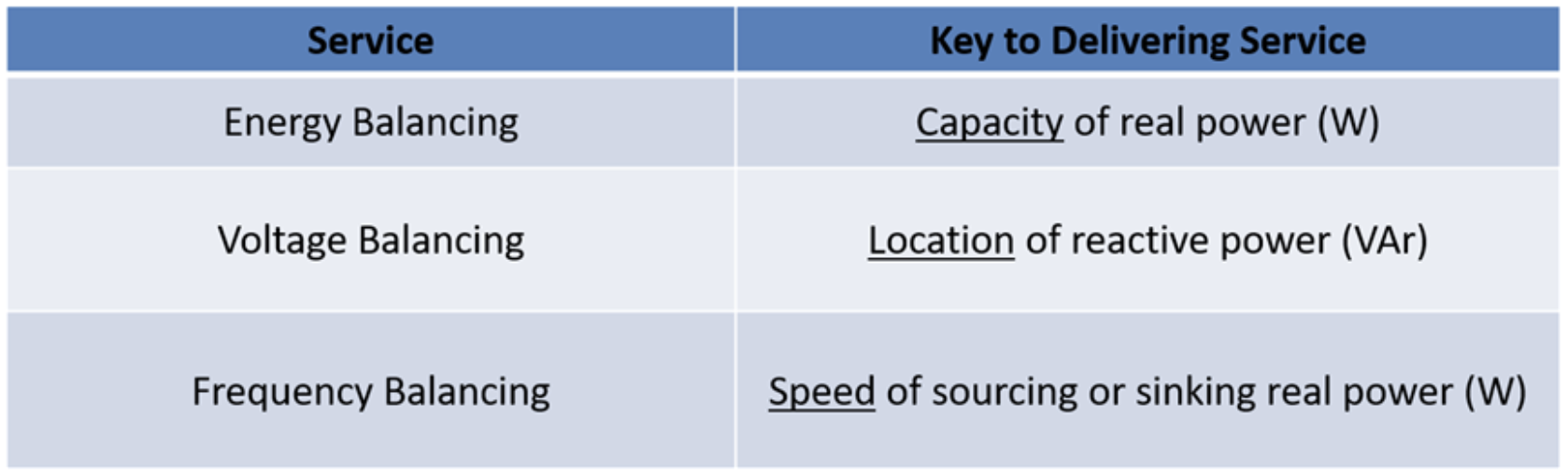
- Grid balancing means continuously matching grid conditions with the capabilities of DER. It occurs across three interrelated dimensions: energy, voltage, and frequency. Energy balancing matches electricity production and consumption over time so that demand is shifted toward hours when generation and grid capacity are available and away from constrained periods – the challenge illustrated by California’s duck curve. Voltage balancing is local: smart inverters can inject or absorb reactive power, or adjust active power, to keep voltage within acceptable ranges. Frequency balancing depends on speed: batteries, EVs, and other inverter-based resources can source or sink real power within seconds — or faster — when system frequency deviates. Together, these services can turn a traditionally passive distribution grid into an actively managed system.
Three Dimensions of Balancing the Grid
Much of the capability needed for GOLD is already embedded in equipment being interconnected today. IEEE 1547-2018 requires inverter-based DER to support advanced voltage, frequency, and ride-through capabilities, while California’s Rule 21 requires advanced smart-inverter functions. But technical capability is not the same as grid optimization. These functions are generally implemented through standardized settings rather than routinely being dispatched and compensated as time- and location-specific grid services.
Hawaii shows what the next step can look like. Hawaiian Electric has moved advanced inverter functions from testing into widespread operation, requiring Volt-Watt functionality for rooftop solar and using voltage data to monitor its performance. Nearly 29,000 DER customers with advanced metering had Volt-Watt activated as of early 2026, with compensation available when operation of the function causes excessive curtailment. By using DER themselves to manage voltage constraints, smart inverters can also help increase hosting capacity — allowing more DER to connect without requiring traditional infrastructure upgrades.
For frequency, PacifiCorp’s Wattsmart Battery program provides a particularly direct example. PacifiCorp dispatches participating customer-owned batteries and, according to its 2025 Clean Energy Plan, uses them to address frequency irregularities on the grid. A distributed battery can therefore provide backup power for its owner while also acting as a fast grid-balancing resource when the system needs it.
- Speed-to-power means using DER and available grid capacity to connect new generation and loads faster while increasing the effective peak-power capacity of existing infrastructure. Rather than treating a local constraint as an all-or-nothing barrier, flexible loads, energy storage, onsite generation, and other DER can allow customers to use capacity when it is available and reduce demand during the limited hours when the system is constrained.
This challenge is becoming especially urgent for large new loads, including hyperscale data centers, EV charging depots, electrified industrial facilities, and other customers seeking tens or hundreds of megawatts of new capacity on timelines far shorter than conventional grid upgrades. Berkeley Lab’s 2026 Speed to Power report identifies more than 40 potential approaches for accelerating large-load connections. Flexible service connections are one of the clearest GOLD applications: a customer can accept automated limits during constrained hours in exchange for earlier energization, rather than waiting years for upgrades sized around an unrestricted peak.
PG&E’s Flex Connect program already applies this model on the distribution grid. Using a DER management system, PG&E coordinates time-varying load limits while longer-term upgrades are built and says the approach has helped participating projects move ahead by 18 to 24 months in many cases. Large loads can also become part of the solution rather than simply a new source of peak demand: managed EV charging, batteries, and flexible computing loads can shift or reduce demand during constrained periods. Even hyperscale data centers are beginning to demonstrate significant load flexibility: Google reported in March 2026 that it had signed 1 GW of data-center demand response with utility partners. Together, these approaches can turn a fixed grid constraint into a manageable operating condition.
- Resilience refers to ensuring that electricity remains available when the broader grid is not, and improving how quickly power can be restored after an outage. Properly configured solar, storage, microgrids, and other DER can sustain critical loads during outages while providing valuable grid services during normal operations. Optimizing the grid for resilience also means deploying resources in locations and configurations that can support community-scale resilience — not just individual facilities. Strategically located DER at critical facilities, commercial centers, campuses, and other community anchors can establish the building blocks for Community Microgrids that keep larger portions of a community powered during widespread outages. The same resources should not have to choose between supporting the grid and supporting resilience; they can be designed to do both.
These grid services are not simply additional benefits to tally after a DER has been installed. They can help determine whether the DER gets installed in the first place. When batteries, smart inverters, EVs, and flexible loads can provide — and be compensated for — capacity, voltage support, frequency response, and other time- and location-specific services, that additional value can improve project economics and lower the effective cost of deployment. Properly designed programs can extend those benefits to a broader range of households, businesses, and community-serving facilities. More DER then creates more flexibility to accommodate electrification and interconnect the next wave of distributed resources without requiring every increment of new load or generation to trigger a conventional grid upgrade.
From grid utilization to grid value
These three dimensions address a fundamental problem with today’s electric system: grid infrastructure is not utilized efficiently.
In 2025, the California Independent System Operator (CAISO) served approximately 239 million megawatt-hours of electricity and reached an annual peak demand of approximately 44,500 MW. Averaged across the year, demand was approximately 27,300 MW—about 61% of the annual peak.
That does not mean that every power line, substation, or distribution feeder had 39% of its capacity available. Constraints are locational and change throughout the day and year. But the disparity between average and peak demand illustrates the larger challenge: the grid must be capable of serving periods of very high demand even though those conditions occur during a relatively small portion of the year, leaving significant infrastructure capacity unused during many other hours.
Virginia has begun addressing the measurement side of the problem directly. In 2026, the state enacted HB 434 and SB 621, requiring its major electric utilities to propose grid-utilization metrics and assess how efficiently existing transmission and distribution assets are being used. The law specifically calls for metrics including distribution peak load relative to total grid capacity, current load relative to potential deliverable load, electricity lost through the distribution system, constrained circuits, and system performance at peak conditions.
Importantly, the law links better measurement to better use of the grid. It directs the Virginia State Corporation Commission to analyze opportunities to increase utilization through non-wires alternatives, including energy storage, customer-owned capacity resources, distributed generation, and virtual power plants. That is the same fundamental opportunity GOLD is designed to capture: using DER to unlock more value from infrastructure before defaulting to additional infrastructure investment.
California does not need to wait for a new metric to see what this opportunity looks like at scale. On September 9, 2026, during extreme heat, Sunrun and Tesla coordinated more than 140,000 home batteries to dispatch more than 580 MW of peak power to the California grid for a three-hour evening period at the request of the California Energy Commission and utilities. The event combined 517 MW from Tesla Powerwalls with 63 MW from additional batteries and was coordinated through the Demand Side Grid Support (DSGS) and Emergency Load Reduction programs. That is what GOLD looks like at scale: existing customer assets aggregated into virtual power plants and dispatched when grid capacity is most valuable. The September dispatch also builds on a program that has scaled remarkably quickly. A 2025 Brattle assessment estimated that DSGS Option 3 battery capacity had grown from just 3.4 MW in 2023 to more than 700 MW in 2025, while finding that the program could deliver net benefits to California even under its base-case assumptions.
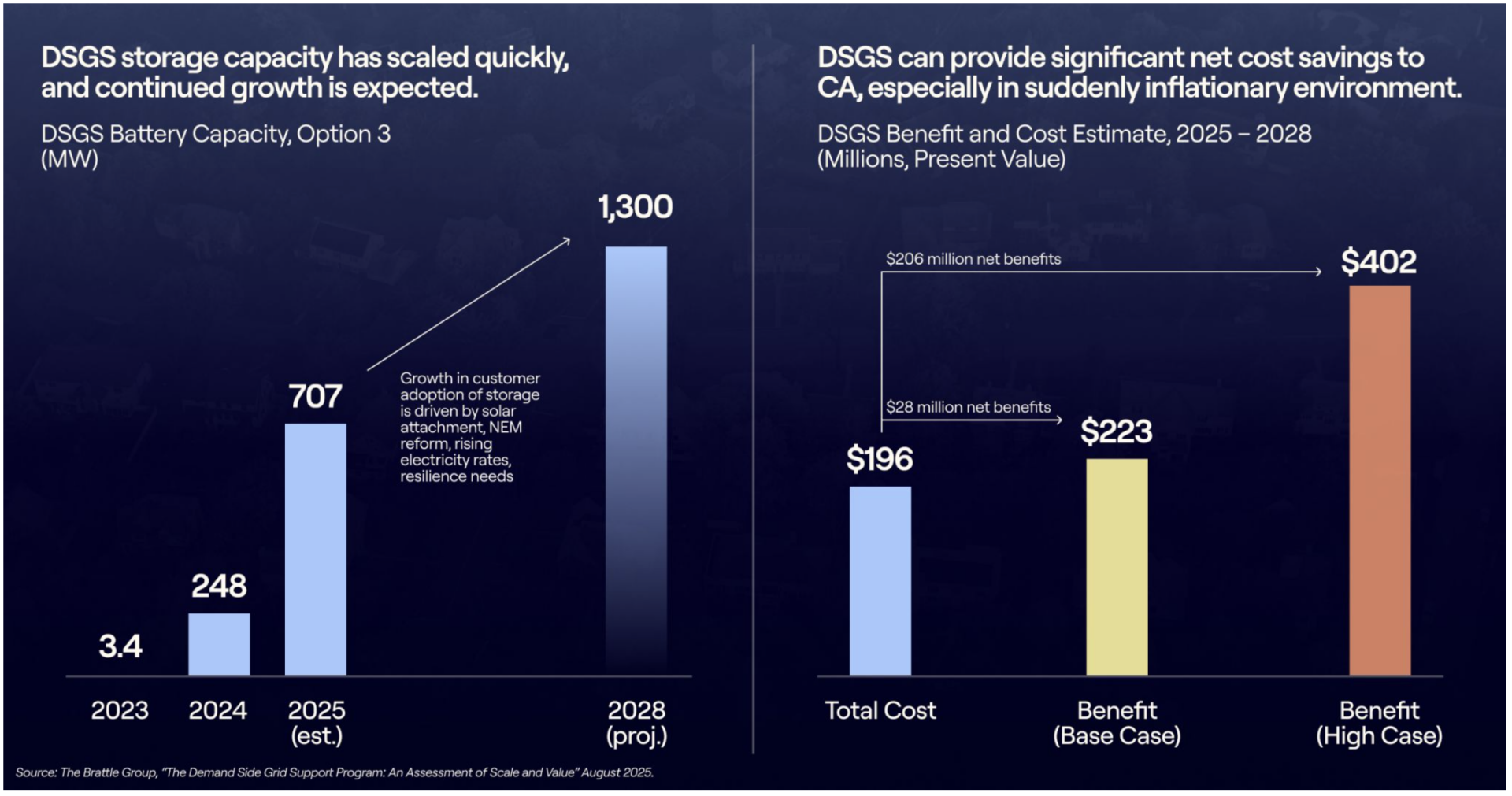
DSGS has rapidly scaled distributed battery capacity, demonstrating clear ratepayer benefits. Source: Brattle Group, The DSGS Program: An Assessment of Scale and Value, August 2025
The 580 MW event in September 2026 demonstrates two things at once: (1) California already has a large distributed fleet capable of changing the system’s operating margin in real time, and (2) compensation mechanisms can turn privately owned assets into dispatchable grid resources. The next stage of GOLD is to make that capability more local and granular. A battery discharging on the right feeder during the right hour can address local energy, voltage, capacity, or resilience needs while simultaneously reducing the amount of power that must travel across upstream distribution and transmission infrastructure. In that way, optimizing the distribution grid can propagate upstream — reducing peak transmission flows, congestion, and marginal losses while freeing existing infrastructure to serve other loads.
Capturing this value systematically will require more granular visibility into how individual grid assets perform, including normal and emergency equipment ratings, time-varying loading, device-specific constraints, and the location- and time-dependent losses associated with moving electricity across the system. A single annual system-loss percentage cannot reveal the marginal losses avoided when a DER serves load at the end of a heavily loaded feeder during a constrained hour. Without more granular information, planners and regulators cannot easily distinguish between infrastructure that is genuinely saturated and infrastructure that is constrained only during a limited number of hours, nor can they fully quantify the value of DER that relieves those constraints.
Measurement alone is not enough. Utilities and regulators also need to account for DER capabilities systematically in planning, procurement, and program design. If grid planning treats DER as passive resources — or considers only their nameplate energy and capacity — it will miss voltage support, frequency response, flexible load, resilience, and other time- and location-specific services that can substitute for or complement traditional infrastructure. Incorporating those capabilities into planning allows their value to be identified; procurement and compensation mechanisms can then pay DER to provide the services the grid actually needs. Britain provides a glimpse of what this can look like at scale. UK Power Networks pays DER and flexible loads to address specific local distribution needs through day-ahead and longer-term flexibility markets, with resources as small as 10 kW able to participate.
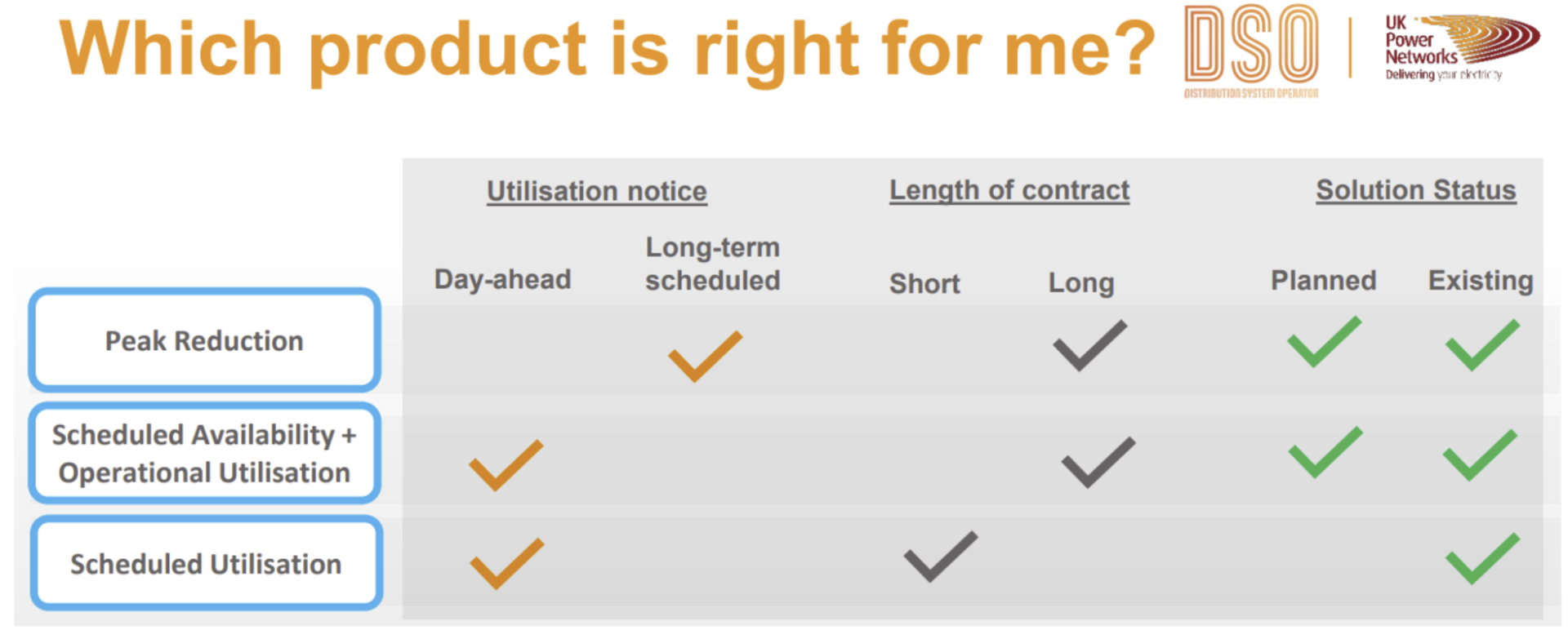
Source: DSO – UK Power Networks Flexibility offering.
By identifying where flexibility is needed and compensating resources for providing it, UK Power Networks can defer traditional infrastructure, accelerate connections, and coordinate distribution-level flexibility with the transmission system. That is the bridge between planning and operation. Clean Coalition’s Energy Tetris framework helps identify where and when DER can create the most system value; GOLD turns that value into operating signals, services, and compensation.
GOLD turns unused grid capability into usable capacity — and latent DER functionality into valuable grid services. California already has the technology and early programs to begin doing this. The task now is to make optimization continuous: measure the grid more precisely, deploy DER where they create the greatest value, and orchestrate them through virtual power plants and other control platforms to balance energy, voltage, and frequency; accelerate speed-to-power; strengthen resilience; and reduce pressure on both distribution and transmission infrastructure. Done well, that can improve DER economics, help broaden access, and accelerate electrification while getting far more value from the grid we already have.