Energy Tetris Part 1: Effectively managing the grid of the 21st century
Transitioning to an integrated grid planning process that embraces Energy Tetris at the distribution level will promote an energy future that is affordable, cleaner, and more resilient.
Energy Tetris Part 1: Effectively managing the grid of the 21st century
By Ben Schwartz and Haley Weinstein
Transitioning to an integrated grid planning process that embraces Energy Tetris at the distribution level will promote an energy future that is affordable, cleaner, and more resilient.
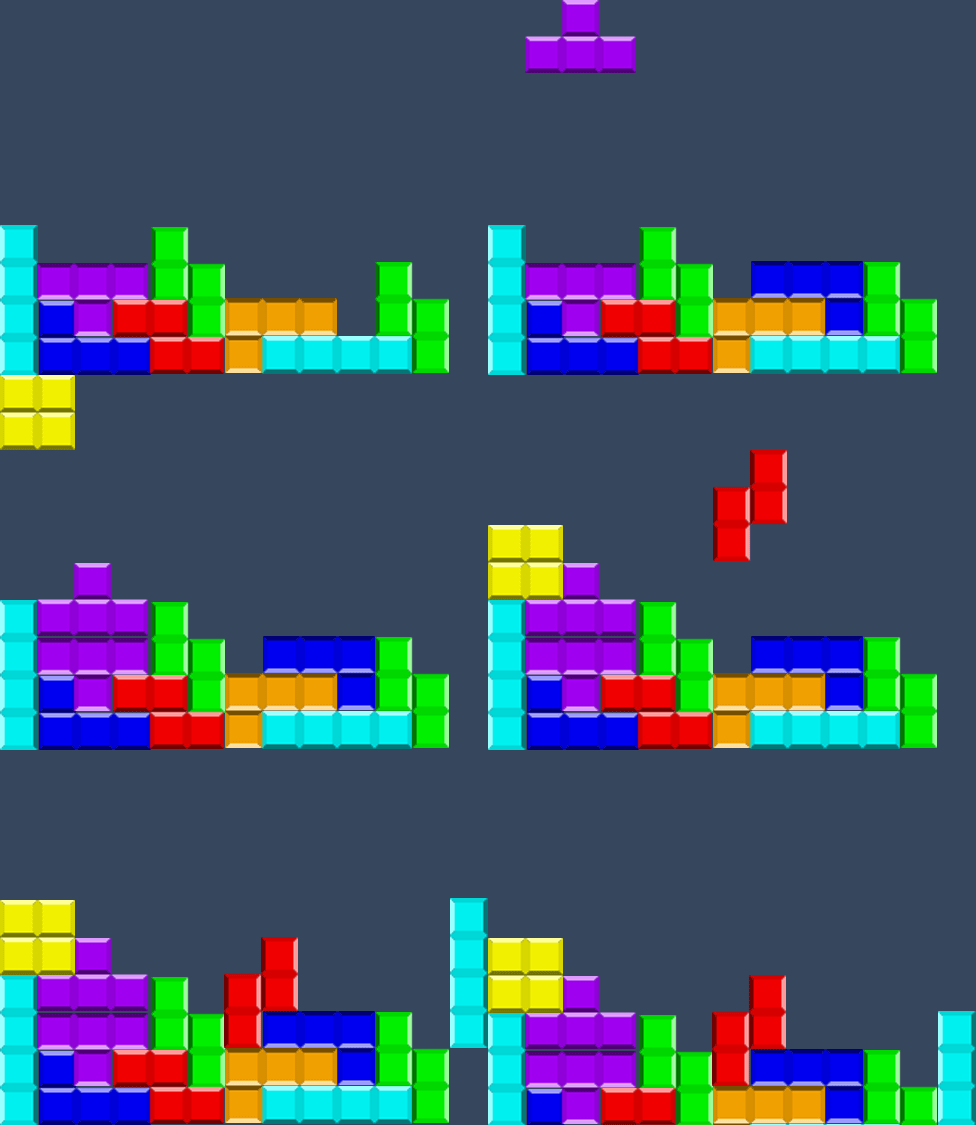
Tetris rewards precision. Players maneuver falling shapes together to complete solid horizontal lines that clear from the screen, keeping the game in motion. Leave too many gaps, and the stack rises until the game ends.
Now imagine California’s electric grid as a massive game of Tetris. Each block represents energy generation, and the goal is to match supply with demand perfectly, in real time. Energy Tetris is primarily a game of physics—are electrons available in the right location to meet demand? There are bottlenecks at every level of the grid that must be managed effectively to avoid costly grid upgrades that lead to rate increases. Failing to fit the pieces together properly results in a grid where infrastructure is overbuilt, clean energy is wasted (in the form of curtailment), and reliance on fossil fuels continues. Meeting the state’s clean energy goals affordably necessitates reducing both the total system peak and the net demand for energy at the CAISO level. Energy Tetris is the answer.
On average, it takes 8-10 years to complete a new transmission project in California.
As the grid modernizes, effective Energy Tetris at all levels is essential, particularly on the distribution grid. Increasing amounts of distributed generation, flexibility, and demand response make it viable to systematically meet loads as close to the point of origination as possible, reducing the impact on the transmission grid at peak times and flattening the duck curve. These opportunities for value creation are unique to the distribution grid and cannot be replicated at the transmission grid level. However, under the status quo, the distribution grid is largely excluded from Energy Tetris and distribution planning is siloed from resource and transmission planning processes. Opportunities for distributed supply and demand side management are systematically being missed. Treating only transmission-connected resources as eligible inputs turns Energy Tetris into a game missing critical shapes, preventing the grid from fitting resources efficiently to load.
Since 2003, California has had a policy hierarchy in place (the Loading Order) to reduce demand at the source and address energy needs locally before deploying wholesale resources or conducting grid upgrades. While not codified in statute, the framework has helped regulatory agencies set goals aimed at reducing energy demand on the grid, keeping load growth relatively flat over the last two decades. However, the emphasis on prioritizing Energy Efficiency, Conservation, Demand Response, and other Distributed Energy Resources (DER) has slipped because of an inability to integrate DER in resource and grid planning processes, leading to the need to reorient through Energy Tetris.
California’s Loading Order (for energy resources)
| 1. Energy Efficiency & Conservation (always first) |
|
| 2. Demand Response, Load Flexibility & Distributed Energy Resources |
|
| 3. Renewable Energy |
|
| 4. Grid Enhancements & Upgrades |
|
| 5. Clean & Efficient Fossil Generation (always last) |
|
The Clean Coalition’s Flattening the Duck Curve article addresses the value of the first two categories of the Loading Order, local renewables and other DER, in avoiding costly grid upgrades investments. As that article explains, deploying these local resources—the top priorities in the Loading Order—directly reduces the need for new transmission and distribution infrastructure, which already makes up nearly two-thirds of electricity bills and is the fastest-growing cost driver for ratepayers. Local solar alone lowers peak transmission usage by roughly 50% of its installed capacity, translating into billions of dollars in avoided transmission investments. Local solar enhanced with paired energy storage and other DER has even greater cost-reduction and grid stabilization benefits, presenting a substantial opportunity if the state uses an ‘Energy Tetris’ approach at the distribution grid scale. Clarifying or formalizing the Loading Order in statute to account for modern grid conditions and technology solutions could help provide a more consistent framework for realizing these benefits across the state.
Energy Tetris Today
Currently, the California Independent System Operator (CAISO) serves as the main balancing authority in California responsible for Energy Tetris, serving 80% of the load in the state and operating real time, day ahead, and extended day ahead markets. CAISO prioritizes grid safety and reliability at the transmission level by managing the high voltage transmission grid and ensuring that the grid can handle the capacity procured via the statewide energy portfolio adopted by the California Public Utilities Commission (CPUC).
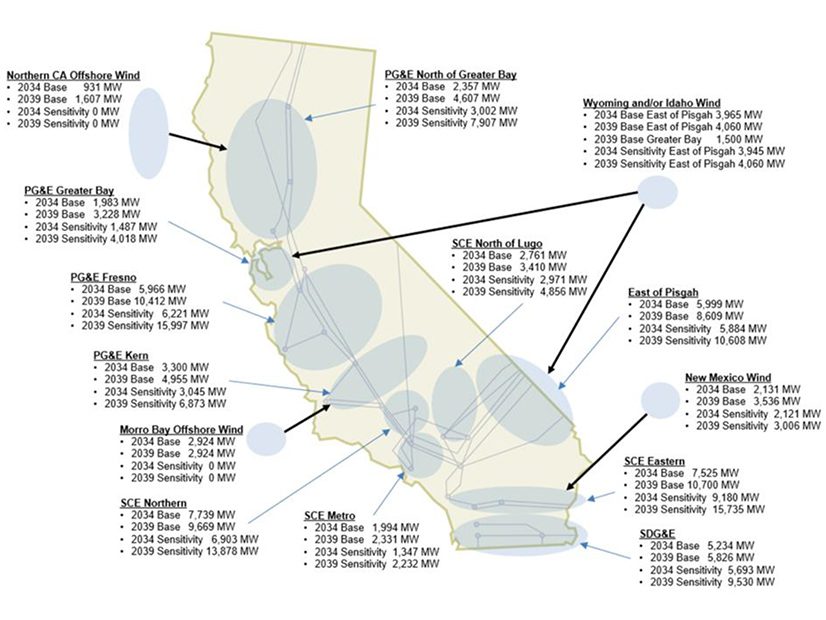
Capacity proposed in each local reliability area in CAISO’s 2025 Transmission Plan
Increasingly, load serving entities (LSEs) like investor-owned utilities (IOUs) and community choice aggregators (CCAs) are also being pulled into the Energy Tetris game. With the slice-of-day framework for Resource Adequacy (RA), LSEs must now procure a sufficient amount of RA capacity to match their gross demand in each hour of the day plus an additional planning reserve margin. Under the previous framework, an LSE only had to reserve enough RA to meet the peak hour of demand in each month.
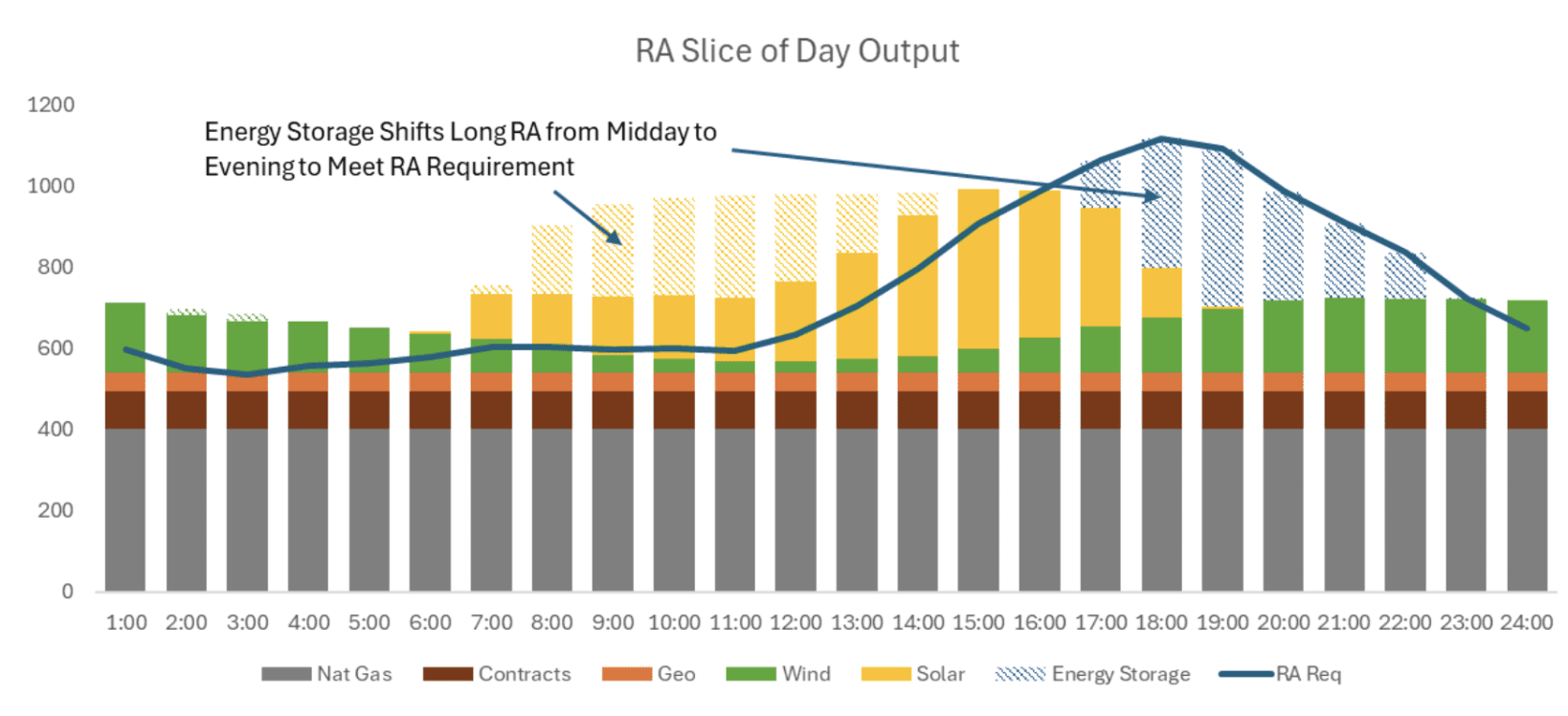
Slice-of-day RA requirement broken down by total demand and type of resource
The chart above shows the consistent reliance on natural gas as RA capacity and the ability of batteries to shift overabundant solar energy produced during the middle of the day to the daily peak—from 5-9 pm—when demand is the highest. In addition to the transition for slice-of-day, SB 1158 (Becker 2022) requires all LSEs to report the cleanliness of their energy portfolio on an hourly basis starting in 2028. This is a major change from the existing counting process, which requires each LSE to bank more renewable energy credits, on an annual basis, than total demand (in kWh). The policy alignment of transitioning to hourly reporting for both RA procurement and renewable content of the energy portfolio is pushing LSEs to participate in Energy Tetris. Albeit a challenging shift for LSEs, balancing load with generation on a far more granular basis than was previously expected poses an opportunity to utilize the existing grid more effectively and reduce ratepayer costs while supporting investments in renewable energy.
For LSEs and CAISO, Energy Tetris is played at the transmission grid level. As discussed in this Clean Coalition article on improving the RA process, RA eligibility is determined via a CAISO study of the transmission grid that awards deliverability to generators. Likewise, the state’s modeling processes—both the SB 100 Report (which maps California’s pathway to achieving its clean energy goals) and the Integrated Resource Plan (IRP) for the state’s energy portfolio—focus solely on transmission interconnected resources. Distributed behind-the-meter (BTM) and front-of-meter (FOM) resources are not included. The exclusion of distributed generation from core energy portfolio planning suggests that the state has not yet fully accepted the reality of a rapidly modernizing grid. Power flows are increasingly bi-directional, and achieving California’s ambitious goals affordably will require granular planning that explicitly accounts for distribution grid topology. Reliance on the levelized cost of energy (LCOE) to determine the state’s energy portfolio should be replaced by a metric that considers the total system benefit (TSB) for the ratepayers based on a number of criteria, not just the upfront cost of generation.
A study by Vibrant Clean Energy found that targeted deployments of distributed solar and utility-scale solar, as opposed to the status quo of using utility-scale resources only, would save California $120 billion by 2050.
Case Study
Energy Tetris on the distribution grid – the Goleta Load Pocket
The Goleta Load Pocket (GLP) is located at the end of Southern California Edison’s grid, encompassing 70 miles of coastline from Point Conception to Lake Casitas, including Goleta, Santa Barbara, Montecito, and Carpinteria. With a reliance on a single transmission easement located in a high fire threat district and an understanding that transmission failures will likely lead to an extended outage, a procurement order for distributed capacity in the region would help meet capacity goals in the CAISO Local Reliability Area and support a vulnerable distribution grid in need of community resilience. Strategically sited DER is an example of Energy Tetris. Targeted deployments of distributed generation and energy storage prepare the grid for a Community Microgrid capable of sustaining the region in the event of an outage while providing an additional benefit: improved power quality. In a region with sophisticated industrial customers that require high-quality reliable power, the precision of the local distribution grid is critical for economic productivity and growth. Front-of-meter (FOM) energy storage systems—with appropriately configured inverters—can balance voltage by adjusting power factor and provide grid forming and black-start services that also balance energy and frequency, naturally improving power quality.
Optimizing the distribution grid with Energy Tetris
A distribution grid operated based on Energy Tetris principles relies on a mix of behind-the-meter (BTM) and FOM distributed solutions to meet demand locally, rather than primarily on wholesale resources. This ‘local first’ approach improves efficiency by reducing stress on the transmission system, supporting bulk-grid market outcomes and lowering congestion costs. Eliminating “duckling curves” at the distribution substations should be as a core strategy for flattening the broader duck curve and easing costs for the ratepayers. Energy Tetris on the distribution grid compliments CAISO’s management of the transmission grid. As described in the Clean Coalition’s Flattening the Duck Curve article, BTM assets reduce the total load served by CAISO while distributed FOM assets reduce the fossil generation needed to meet demand. For grid operators, a substation that presents a steady, predictable profile to the bulk system while cutting fossil reliance is the ideal foundation for a stable grid.
Raising capacity factors is a key Energy Tetris strategy to more effectively utilize existing grid assets and reduce the number of grid upgrades needed to meet clean energy goals, enabling a more affordable grid modernization process.
Energy Tetris inherently means including locational value in grid and resource planning. While ultimately a strategy targeted at reducing the amount of energy imported at the distribution substation level (from the transmission grid), avoiding distribution feeder or transformer upgrades through energy management and flexible connections are also avenues for ratepayer savings if Energy Tetris opportunities are maximized. Granular grid planning that incorporates available DER and highlights areas on the distribution grid where new deployments can prove the most value will improve utilization of the existing grid and limit upgrades to least regrets investments. For example, two projects in SCE’s distribution deferral pilot avoided transformer upgrades, providing combined ratepayer savings of $7.56 million. If opportunities for avoiding upgrades are presented, the market will make solutions available to meet the need. Piclo’s grid flexibility marketplace is another alternative Energy Tetris strategy, where a market platform enables DER providers to see locations on the grid where providing flexibility is valuable. With markets in the UK and pilots in other states, Piclo is demonstrating that procuring flexibility on a more granular basis than considered in existing grid planning processes could be a viable pathway to unlock additional ratepayer savings via DER.
Strategic investments in DER deployed on built environments can extend the life of existing grid infrastructure, enhance ratepayer investment value, obviate gas peaker plants, and provide the added benefit of protecting California’s natural lands.
California is already approaching 250,000 BTM battery deployments. Many of these assets can be aggregated into Virtual Power Plants (VPPs) that reduce peak demand during critical periods, prevent outages, and enhance grid reliability. However, on a daily basis, shifting loads to the middle of the day when solar energy is abundant is the most impactful way to reduce the system peak and ratepayer costs. The intermittency of individual distributed resources is complemented by diversity on both the load and generation sides and a grid operator that follows the Energy Tetris mindset. Aggregating many different DERs and flexible loads smooths out variability and increases reliability.
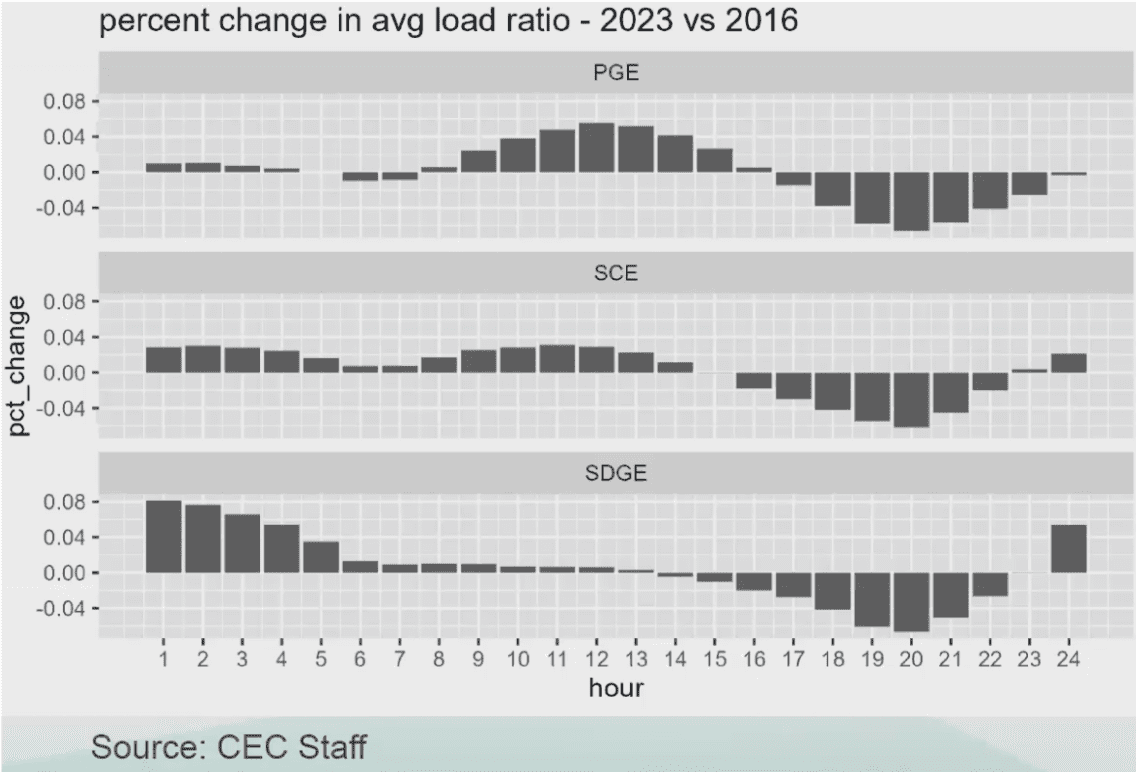
Between 2016 and 2023, the system load during peak hours has gone down and demand during the middle of the day (solar producing hours) has increased. This is an example of successful Energy Tetris.
The graph above is a great example of how targeted policies can change consumer behavior so demand increases at times that align with grid conditions and have a high renewable energy content. Other examples of distributed demand side and supply side Energy Tetris solutions will be explored in the next two articles in the series.
California faces the Energy Tetris challenge every day as solar output surges at noon and falls off as the sun sets. Distributed solar and battery storage and other DER deployed near where people live and work are needed to provide local clean energy to meet demand in the most efficient ways possible. Resources sited on built environments can simultaneously preserve California’s natural lands, reduce demand on the transmission grid to help avoid costly upgrades that burden ratepayers, and support resilience goals, meeting multiple policy objectives. To fully conquer the evening ramp and meet clean-energy goals affordably, California needs to play Energy Tetris—a coordinated mix of demand-side control and supply-side management that makes the most of our existing grid—at both the transmission and distribution levels.