
Plug-In Solar Is Moving From Workaround to Mainstream
A practical guide to what plug-in solar is, where it is legal, what legislation is moving, and how to choose the right system package and components.
Plug-In Solar Is Moving From Workaround to Mainstream
A practical guide to what plug-in solar is, where it is legal, what legislation is moving, and how to choose the right system package and components.
Plug-in solar and Energy Tetris: the missing small piece that can make the grid fit better
Clean Coalition’s Energy Tetris framing is a useful way to understand why plug-in solar matters beyond an individual electric bill. In Tetris, the goal is not to drop the biggest block; it is to place the right shape in the right location at the right time so the whole stack clears cleanly. The modern grid has the same challenge. Electricity has to be available when and where demand appears, while avoiding expensive gaps of overbuilt infrastructure, wasted midday solar, expensive fossil fuel generation in the evening peak, and transmission and distribution upgrades that push rates higher.
Energy Tetris separates two problems that are often blurred together. Total demand is the physical peak the grid must be built to handle. Net demand is what remains after large-scale wind and solar reduce the energy CAISO must serve, especially during the middle of the day. Utility-scale renewables can lower net demand, but they still depend on transmission to move power and do not automatically reduce the local distribution peaks that drive grid infrastructure costs. Distributed energy resources—local technologies and programs that generate, store, and shift electricity near the point of use—can reduce the total demand when they are placed near matching load and operated during periods of grid need.
That is the bridge to plug-in solar. An outlet-connected solar system is small by traditional power-plant standards, but it is exactly the type of ‘local’ block Energy Tetris is asking planners to consider. Even a small system is able to help offset refrigerator, router, HVAC fan, work-from-home, and device-charging loads where those loads occur. When paired with a battery or smart controls, plug-in solar can shift some midday production into the evening peak. Scaled across apartments, condos, backyards, and even accessory-dwelling units (ADUs), these systems can become part of the same local-first strategy Clean Coalition promotes: use the existing grid more efficiently before defaulting to a costly infrastructure buildout.
The policy implication is clear: plug-in solar should not be treated only as a consumer gadget or a workaround for people without rooftop access. Through an Energy Tetris lens, plug-in solar is better viewed as a practical distribution-level resource that expands built-environment solar close to load, reduces pressure on peak infrastructure, supports self-consumption, and brings renters and apartment dwellers into the distributed-energy resource mix that California and other states increasingly need.
Balcony-mounted solar panels demonstrate how plug-in solar can expand access to local clean energy for renters, apartment dwellers, and households without traditional rooftop solar access. Photo: Mother Jones, “New Hampshire and Vermont Could be Next to Introduce ‘Balcony Solar’.”
Place, plug, & save
Plug-in solar—often called balcony solar, backyard solar, or plug-and-play solar—is one of the most accessible clean-energy technologies now gaining traction across the US. Without requiring a costly rooftop array, a multi-day installation, or a complex utility interconnection process, these systems allow households to offset a meaningful share of the electricity they use. For people who have been locked out of the traditional market, plug-in solar makes personal solar accessible due to the simplicity of the three-step setup process:
- Place the panels on a balcony, patio, backyard rack, or approved mount,
- Plug the system into a dedicated GFCI-protected outlet, and,
- Use the solar energy inside the home rather than buying costly energy from the grid.
For renters, apartment dwellers, and homeowners who cannot pursue a full rooftop installation, that simplicity is the breakthrough.
Like daytime EV charging, plug-in solar works best when usage and timing line up.Many homes have constant background loads—refrigerators, routers, HVAC fans, laptops, chargers, lighting, and smart-home devices—and solar generation is strongest during the day. A small system can reduce those baseline loads. Add a battery, and daytime solar can be shifted into the evening, when many utilities charge higher time-of-use rates.
Where plug-in solar is legal
Driven by changes in policy, adoption of plug-in solar is growing quickly in the US. After Utah established the first model in 2025, there has been a surge of interest, leading to multiple states passing legislation thus far in 2026. As of the publication of this article, seven states have laws on the books authorizing plug-in solar, though several have not yet taken effect. Most of the state laws align around the same core ideas: modest system size limits, anti-islanding protection, nationally recognized safety certification, no traditional interconnection agreement, and no extra utility fees for qualifying devices. While the standard cap for system size limit is typically 1,200W—enough for two or three modern panels—Colorado stands as the outlier with a cap of 1,920W.
States with signed laws authorizing plug-in solar
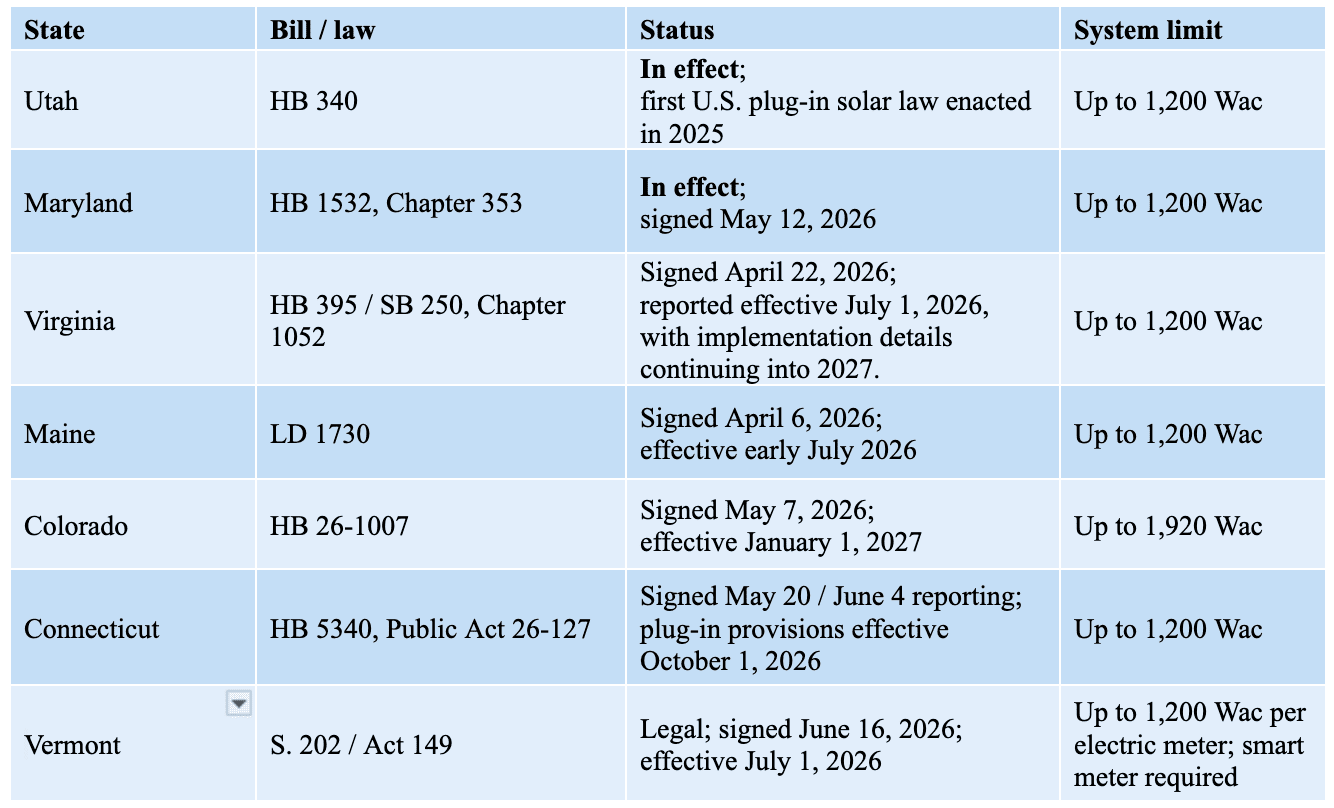
As the legal landscape continues to evolve, PlugInForSolar.com provides a state-by-state resource, updated on a monthly basis, for tracking where plug-in solar is authorized, where legislation is pending, what basic system requirements consumers should review before purchasing or connecting equipment, and which available products may best fit their needs. Product listings are also updated frequently, allowing users to compare their options with greater confidence before they buy.
News in states with pending legislation
While there have been discussions about plug-in solar in roughly half of US states, the most lively debates surrounding active legislation are concentrated in high-electricity-cost states and renter-heavy markets. The states below are the ones to watch most closely.
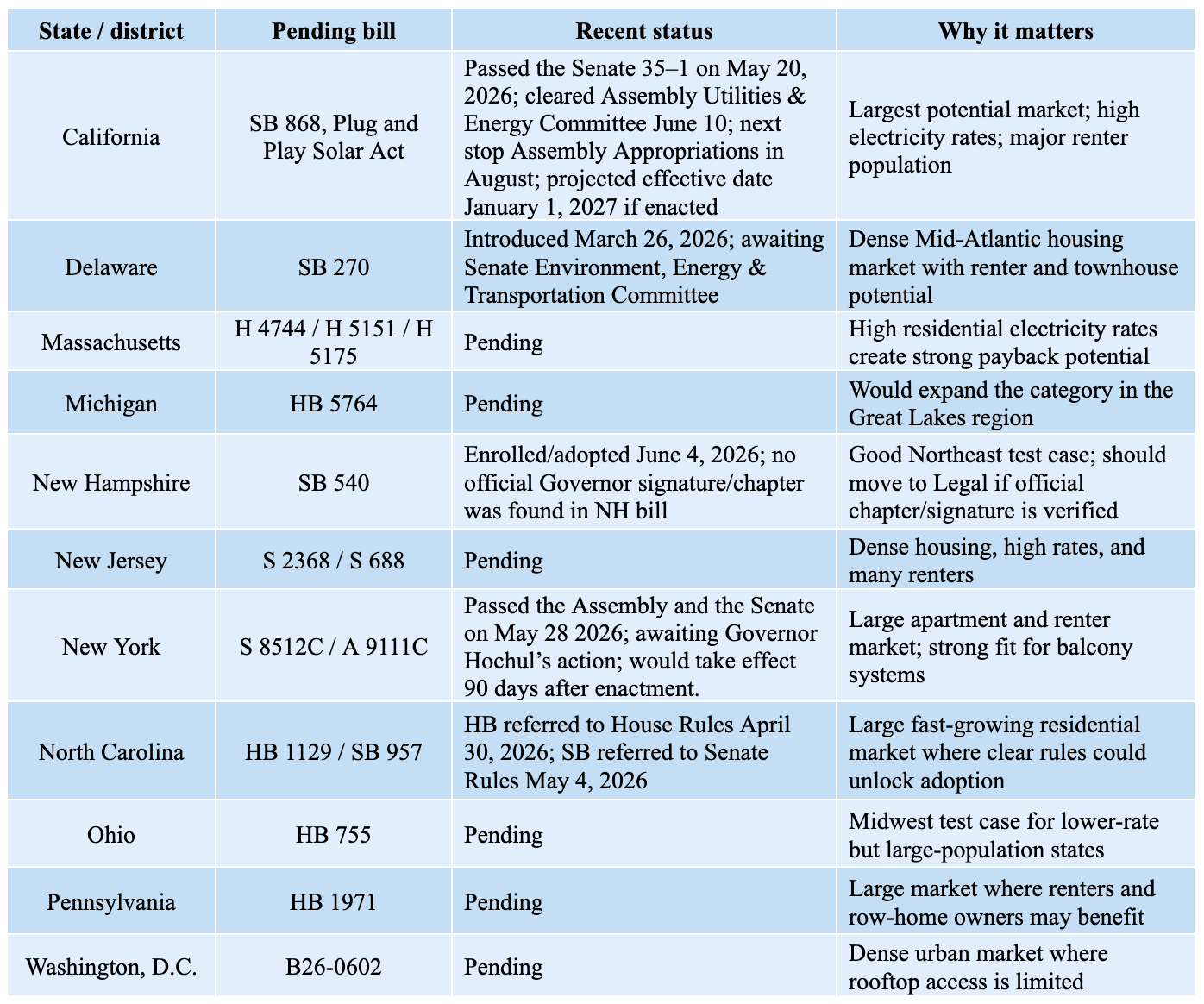
That legal structure matters because plug-in solar is technologically simple but institutionally underdeveloped in the United States. Without clear authorization, manufacturers, retailers, utilities, inspectors, landlords, and consumers are left navigating a patchwork of uncertainty: whether systems are allowed, whether utility registration is required, what installation instructions apply, how inspections should be handled, and what products can be sold with confidence. State laws do more than permit individual systems; they create the market rules that allow the surrounding ecosystem to mature.
California would become the most influential state market to authorize plug-in solar if SB 868 becomes a law. Implementation in what is the fourth largest economy in the world could accelerate product availability, retail education, utility registration systems, and landlord/tenant guidance across the country. With nearly 40 million residents and high electricity prices, California’s market is large enough to move manufacturers from initial investments and cautious pilots into mainstream product launches across the US.
Where plug-in solar remains unauthorized
Most state rules governing solar, resource interconnection, and electrical codes were written for traditional rooftop solar systems that primarily serve onsite customer loads and are able to export excess energy to the grid. Plug-in systems do not fit these frameworks because the legal and safety rules for small outlet-connected generation remain underdeveloped. Without a clear legal classification or approval pathway, market participants and implementation authorities are left to navigate unresolved certification, connection, registration, and compliance requirements. Although this gap is not an outright ban, it results in the same practical effect: without an explicit pathway for plug-in solar, there is no clear legal basis for use through a building’s electrical system. Until a state’s legislation catches up, consumers in those states should treat outlet-connected plug-in solar as unavailable as a conservative compliance measure, unless local rules, utility guidance, and equipment certifications clearly allow it.
Bills introduced but deferred: Alaska, Arizona, Georgia, Hawaii, Idaho, Illinois, Indiana, Iowa, Minnesota, Missouri, New Mexico, Oklahoma, Oregon, Rhode Island, South Carolina, Washington, and Wyoming.
Status Unclear: Alabama, Arkansas, Florida, Kansas, Kentucky, Louisiana, Mississippi, Montana, Nebraska, Nevada, North Dakota, South Dakota, Tennessee, Texas, West Virginia, and Wisconsin.
For customers in these states, the safe guidance is to not connect a grid-interactive plug-in solar device unless local rules clearly allow it, the equipment is certified for that use, and the outlet/circuit requirements are met. Off-grid portable solar and battery products are different, as those can be used as standalone systems, but should not be backfed into a household outlet.
What is inside a plug-in solar system?
Plug-in solar’s accessibility depends on more than its small system size. To function as a safe grid-interactive resource, the system must use certified equipment, safe power conversion, appropriate outlet and circuit conditions, and controls that prevent backfeed and unsafe operation. Understanding the core components helps explain what makes a system compliant, what determines whether it can shift energy into later hours, and why a plug-in setup is different from portable off-grid batteries and from full rooftop solar-plus-storage systems.
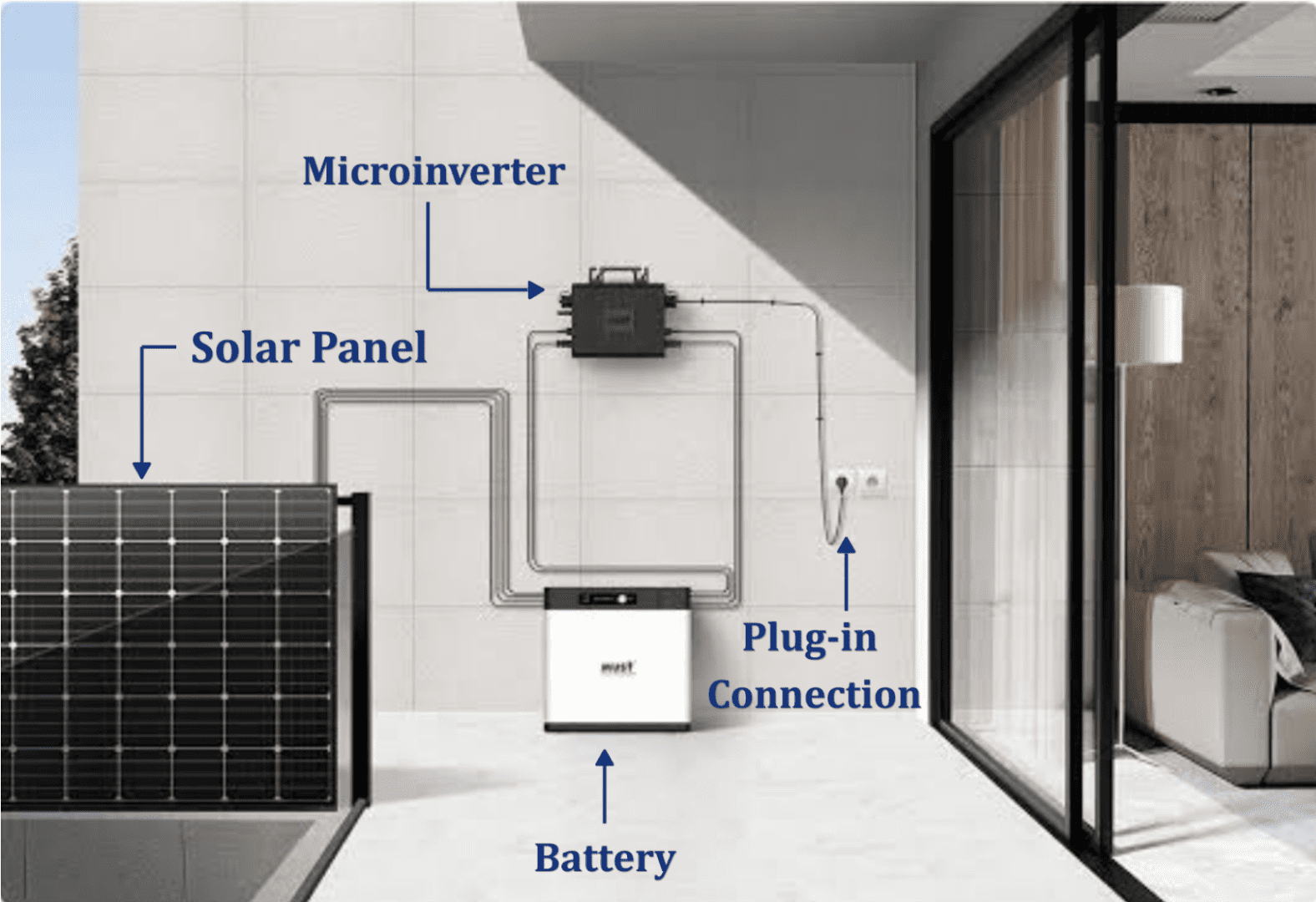
Example plug-in solar configuration with a solar panel, microinverter, battery storage, and plug-in connection. Image: MUST energy, “Balcony Solar System PM Series + HPC Series.”
Solar panels
The panels are the power source. Most plug-in solar packages use high-efficiency monocrystalline panels in the 200W to 500W range. A single-panel system is simple and renter-friendly. Two- and three-panel systems can make a noticeable dent in household baseload. In Colorado, where the legal limit reaches 1,920W, larger four- or five-panel systems become possible. Panel selection should consider wattage, physical size, wind rating, warranty, and whether the panel fits the customer’s balcony, patio, yard, or wall-mounted racking option.
Plug-in solar microinverters
The microinverter is the grid-facing control point. Solar panels produce DC electricity and homes use AC electricity. A plug-in solar microinverter converts panel output into household AC, synchronizes with the grid, and shuts down automatically during an outage through anti-islanding protection. For legal compliance, customers should look for equipment certified by a nationally recognized testing laboratory, with the newer UL 3700 safety framework becoming the plug-in-specific benchmark and the older UL 1741 framework remaining relevant for inverter safety. For compliant installation, the microinverter should only be connected to a dedicated GFCI-protected outlet or circuit, consistent with applicable electrical code. It should not be connected to an extension cord, power strip, or shared household outlet.
Batteries and energy storage
Batteries turn plug-in solar from a daytime bill reducer into a flexible energy tool. The main value is time shifting: store extra midday production and use it during evening peak-rate hours or after the sun goes down. Some batteries also have appliance outlets that can power individual devices during an outage, but that is different from islanding the home’s wiring. Without a compliant transfer switch, critical-load panel, or other approved backup equipment, a plug-in system should not be described as whole-home backup.
CT clamps, smart meters, and monitoring
CT clamps—current transformer clamps—and smart meters measure electricity flowing through a circuit or service conductor. In a plug-in solar system, they help the inverter or energy-management software understand when the home is consuming power and when excess generation might otherwise flow back toward the grid. That data helps maximize self-consumption, limit export where required, and give the customer a clear app-based view of production, usage, and savings. CT clamps should be installed only where the manufacturer permits and local electrical rules allow; in many cases an electrician should handle installation.
Racking and mounting options
A plug-in solar system is only as good as its mounting. Racking has to fit real living spaces: apartment balconies, patios, fences, backyards, flat roofs where allowed, and ground-mounted frames. Common options include weighted patio racks, balcony rail mounts, adjustable tilt ground racks, wall-adjacent frames, and portable folding stands. The criteria are stability, wind resistance, non-damaging installation for renters, good sun exposure, and compliance with landlord, HOA, and local safety rules.
Plug-in solar packages vs. single products: what to buy and when
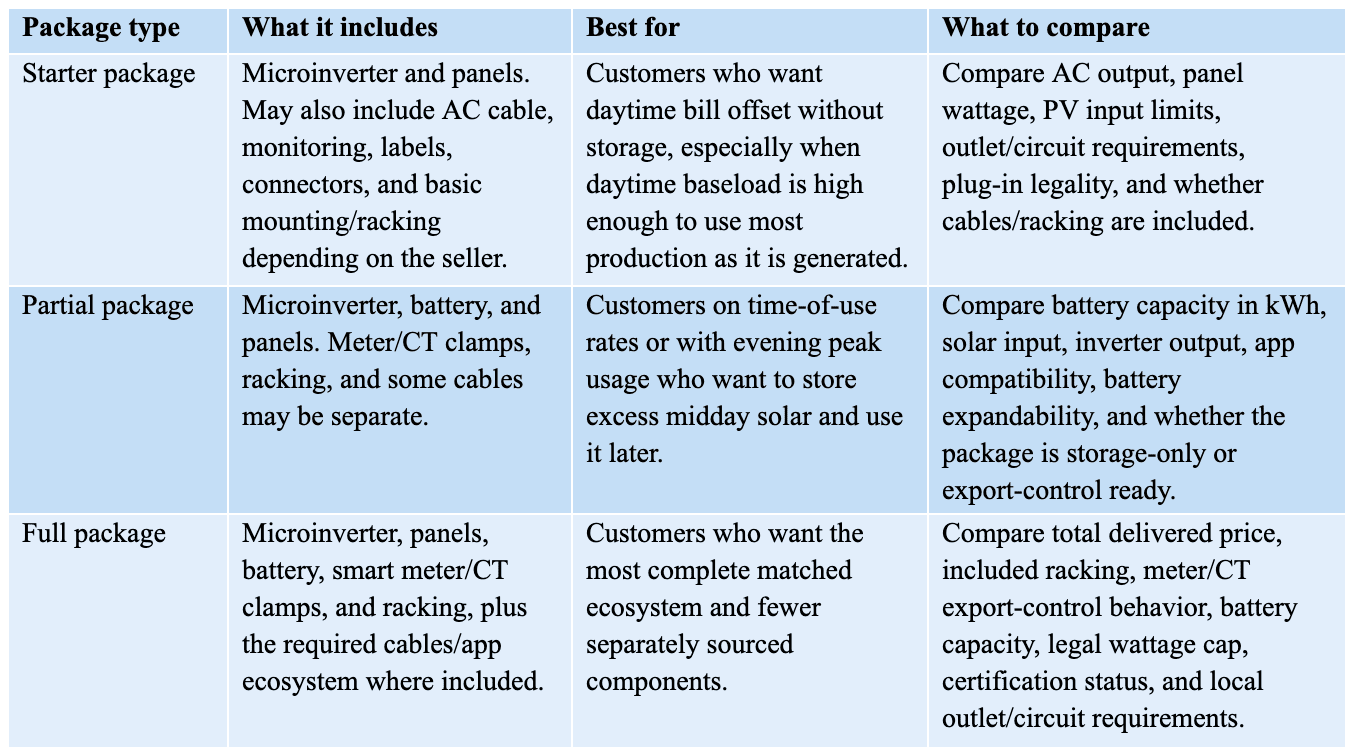
Choosing between a plug-in solar package and individual components depends on the customer’s location (state authorization of plug-in solar), available space, utility rate design, renter or owner status, and preference for simple daytime offset or solar-plus-battery time shifting. As referenced by pluginforsolar.com, packages are best for customers who want a more standardized setup with components designed to work together, while single product purchases make more sense for customers who already have panels, require a specific mounting option, or are comparing components for cost or performance. The table below outlines the main package types and which customers each option is best suited for:
Why this matters for renters, homeowners, and the grid
Plug-in solar will not replace rooftop solar, community solar, or utility-scale renewables. It is a new category with a different function: make personal-scale solar accessible to people who have been locked out of the traditional market. Renters can start with a small system and take it with them when they move. Homeowners can reduce electricity bills without committing to the investment of a full rooftop solar project. Property managers can offer a visible clean-energy amenity in a manner that helps address the split incentive problem. In each case, a plug-in solar system that is a fraction of the cost of a rooftop solar system and far simpler to install and connect can provide meaningful savings.
Every well-sited plug-in system is a small, but local resource, that can serve nearby load before power has to move across the transmission system. One system may only offset a slice of baseload, but aggregating systems can make a real contribution to reduce demand, improve use of the existing distribution grid,. By pairing plug-in solar with battery storage and smart controls, bill savings can extend into the evening, reducing pressure on the grid during expensive peak periods and improving household resilience. That is the core challenge of Energy Tetris in plain language: effectively match available clean-energy blocks to the right load, in the right place, at the right time, before asking ratepayers to fund additional costly infrastructure projects.
Utilities and regulators can support plug-in solar by providing clear safety rules to streamline project designs and avoid interconnection confusion.The more safely and predictably these systems can be deployed, the easier it becomes for policymakers, utilities, and customers to treat them as real local grid assets rather than edge-case devices.
Reader Resources: Example Plug-in Solar Packages and Components
Commercially available package types:
- CraftStrom 1200 DC-Watt Plug&Play Solar — $3,238.50 for 1,200W of panels, about $2.70/W. Includes six 200W bifacial panels, mounting, three 400W smart inverters, Smart PowerMeter, AC cable, app, and accessories.
- PluggedSolar 800 DC-Watt plug-in kit — $1,449 for the 800W no-mounting variant, about $1.81/W; ground and roof mounting variants were listed at $1,599 and $1,549, about $2.00/W and $1.94/W.
- EcoFlow STREAM Ultra + 4 × 400Wdc rigid panels — $2,799 for 1,600W of panels plus a 1.92kWh battery/inverter unit, about $1.75/W based on panel nameplate. This is a solar-plus-battery time-shifting product.
- Zendure 1,640 DC-Watt SolarFlow Kit — U.S. product page for plug-in solar with battery, Hub 2000, Smart Meter CT mode, and AB2000S battery expansion.
Commercially available single products:
- Solar panels — Check Facebook Marketplace, Craigslist, local installers, surplus resellers, and pallet buyers. Local pickup may avoid freight fees, residential delivery charges, minimum order quantities, and damage risk.
- Examples of other popular online retailers include Current Connected and A1 SolarStore.
- Plug-in solar microinverter: APsystems EZ1 Series — Up to ~800 Wdc depending on model/region, DIY-friendly, plug-and-play design, real-time monitoring on your smartphone, built on proven APsystems technology and expandable.
- Smart energy meter: APSystems EZ1 Zero Export Control (APmeter) — Smart (zero) export control for EZ1 plug-in solar. Working with the AP EasyPower app and cloud-based controls, the APmeter helps optimize self-consumption, reduce grid export, and support compliance with utility and grid requirements.
- Batteries for plug-in solar: BigBlue Powafree H1 — A 2,560Wh LiFePO4 battery designed to sit between solar panels and a microinverter. It uses its PV controller and LiFePO4 battery to store excess solar energy and later feed controlled DC power to the microinverter.
- Solar racking: Solar Module Bracket Hooks for Balcony or IntegraRack IR-45ASA Solar Panel Ground Mount | 15-45 Degree Adjustable Angle — Bracket hooks for balcony solar or ground mount racking for backyards.